This Marklin HO scale layout gallery walks through 15 photos of a finished European pike. In fact, the pike was built in a German operator’s room. You will see catenary-wired mainline track, DB Cargo electrics, period steam locos, and a half-timbered village. Each photo below shows a specific technique worth copying. So whether you are planning your first oval or already running operating sessions, there is something here for you. For the scenery techniques that hold a pike like this together, the beautiful scenery track planning walkthrough covers the same ground in detail.
The layout is built around classic Marklin three-rail HO equipment. The era is German Bundesbahn, roughly the 1960s through the 1990s. That single decision drives everything you see. For example, you get red DB and DB Cargo electrics, green E52 locos, semaphore signals, and half-timbered Bavarian houses. So coming from American HO, you get a useful reference for a disciplined European pike. For more on HO scale scenery ideas, see the separate guide.
What Makes This Marklin HO Layout Worth Studying
First, a good Marklin layout is built around the catenary, not despite it. Overhead wires set the era. They also set the loco roster and the photo angles. On this pike the catenary is consistent across every track in every photo. Even the staging ladder has wires. So the whole layout reads as a complete system rather than a series of separate scenes. Small details confirm the prototype, too. Look at the kilometer marker post or the semaphore signal on its own.
Second, the builder is willing to leave space empty. The yard overhead shot has long parallel tangents with nothing on them. Grass between the engine shed and the freight yard is not crowded with figures. The village scene has the two houses separated by lawn rather than packed together. That restraint is what makes the layout read as a real place. Small layouts work best when the builder resists filling every square inch.
1. Yard Overhead With Tunnel Portal and Hillside Reverse Loop
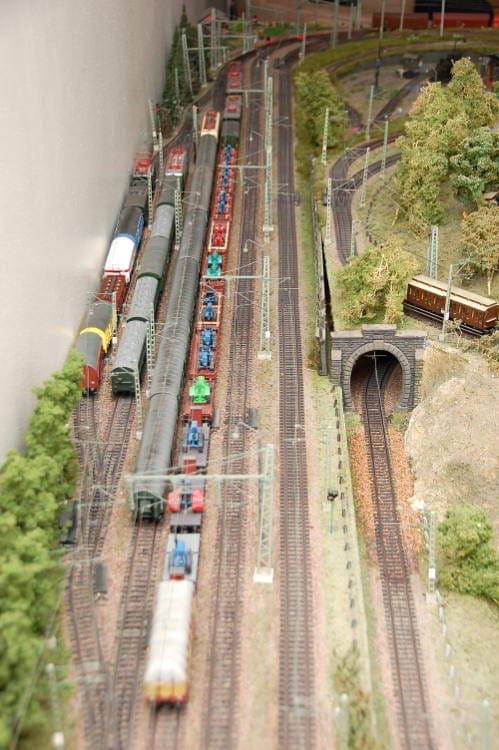
This is the layout’s catenary-wired freight yard seen from above. Three or four parallel tangents carry mixed freight and tank cars under the wires. Meanwhile, the wall edge sits on the left. On the right, a stub tunnel portal is cut into a curved hillside. The hillside hides the reverse loop. With that one feature, you can turn a complete train without manually re-positioning equipment.
In short, tunnel placement is the lesson here. The portal sits exactly where the mainline disappears into the hillside. There is also enough rock face above it to read as a real cut. Behind the hill, the track curves through whatever radius the room allows. It then feeds back into the yard from the other end. So if you have a wall on one side and a corner to work with, copy this geometry.
2. DB 140 288-2 Red Electric Loco on a Curve
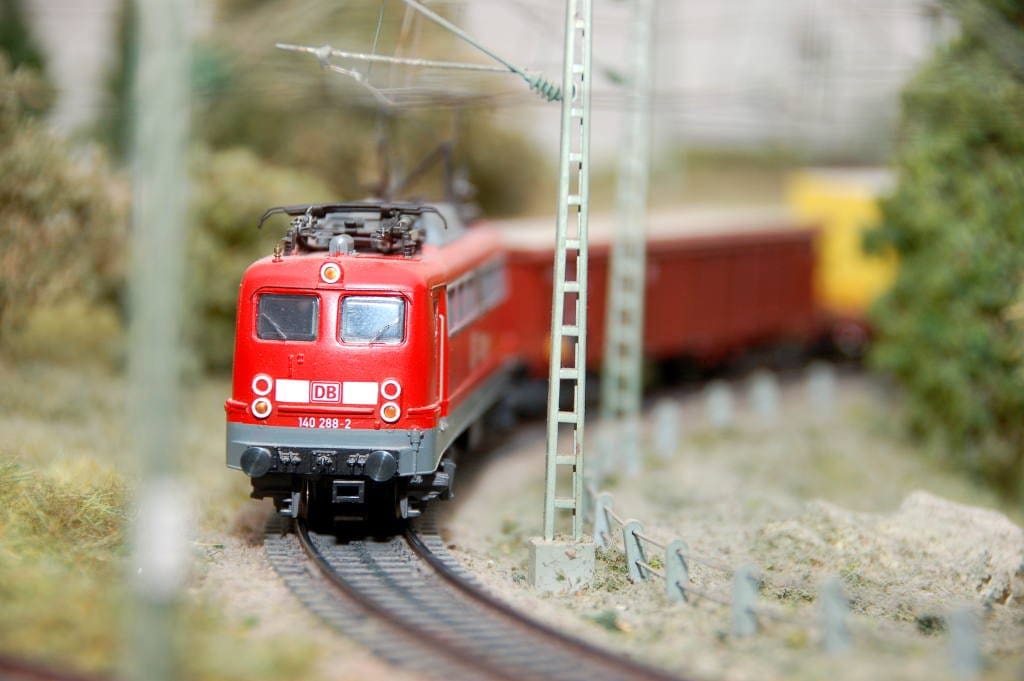
In this photo, a Deutsche Bahn class 140 electric threads a tight curve. The livery is DB red. The number is 140 288-2. Behind it, an open boxcar trails along. The Marklin catenary mast sits in sharp focus in the foreground. Meanwhile, the loco face and the dirt embankment behind it are softly defocused. The camera is at near track level and tilted slightly downward.
The class 140 ranks among the most common DB electrics of the postwar era. So it makes a good starting loco for a German-outline layout. The photo is worth studying for the camera position more than the equipment. The position is low and close, with a foreground catenary mast as a framing element. Track-level photography is where European catenary layouts pay off. The wires and masts give the camera something to compose against.
3. Steam Tank Loco at Coaling and Watering Station
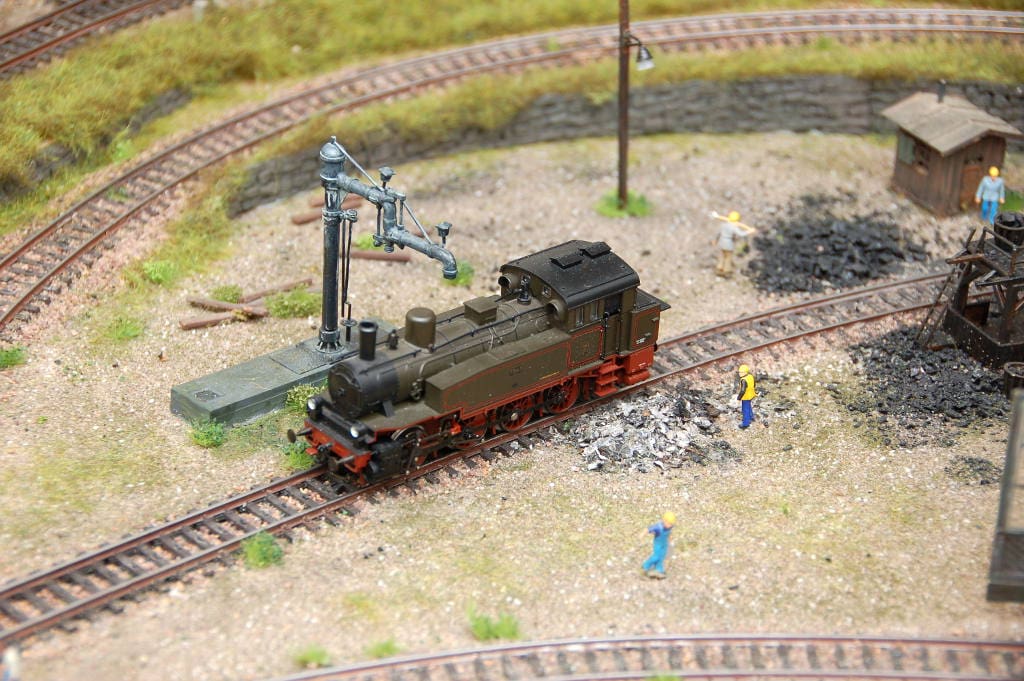
A black Marklin steam tank loco sits on the curve. Next to it stands a tall iron water column and a coaling pile. Two yellow-jacketed worker figures stand in the foreground, with one more in the middle distance. In addition, the track is laid on weathered stone ballast. The surrounding ground is brown earth with sparse green patches. A small wooden engineer’s shack stands at the right edge.
This kind of detail scene is where the layout earns its photo gallery. For instance, the watering column is a real working piece of locomotive servicing equipment. The coal pile is actual scenic coal rather than painted plastic. Also, the figures are placed where workers would actually stand. One is filling the tender. Another is walking toward the shack. A third is further out doing yard work. Both Marklin and Preiser sell figures cheap. Five minutes spent placing them in motion-implied poses adds more to a scene than another locomotive.
4. Stone Tunnel Portal Close-Up With Rock Cut
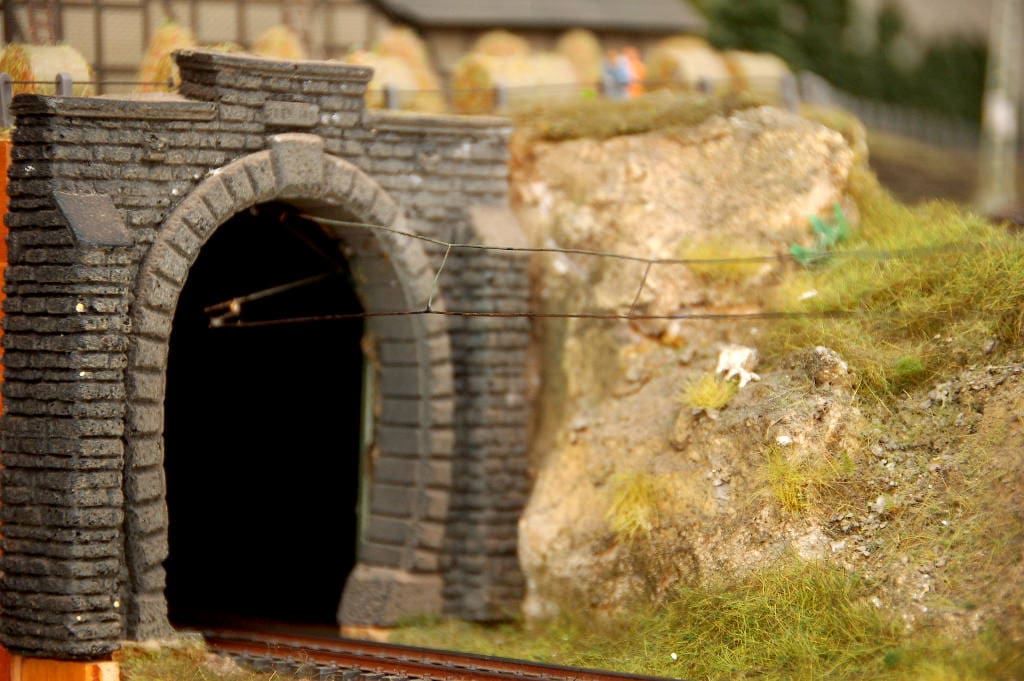
A close-up of a Marklin stone-arch tunnel portal fills the frame. The catenary wires run into the dark opening. A roughly textured tan rock cut climbs up to the right. In addition, the mortar lines in the portal stones are weathered with a gray wash. Also, a small white goat figure is tucked into the rocks at the right edge.
Rock work to either side is the trick on tunnel portals. A bare portal against a flat backdrop reads as a model accessory. However, a portal blended into a sculpted rock cut reads as real landscape. The blend uses multiple wash colors and tucked-in details. The hidden figure in the rocks is the kind of detail people notice on the second or third look. That is the whole point.
5. German Semaphore Signal in the Grass
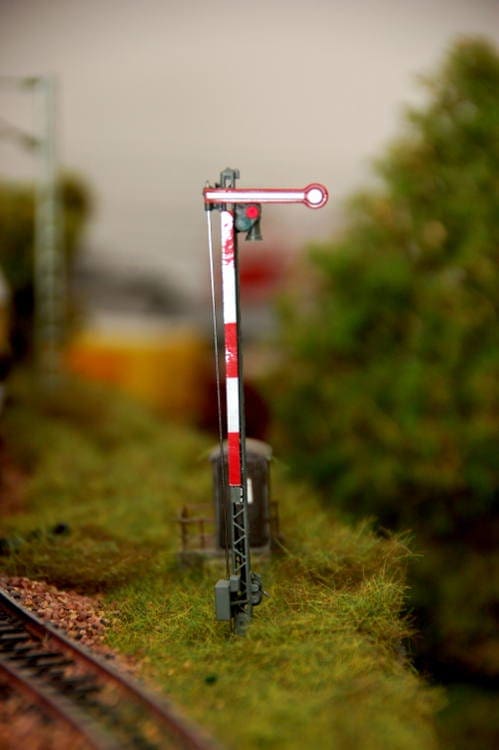
A standalone German semaphore signal stands next to the rail. The post is white and red striped. The arm is red and white. Around it, tall summer grass surrounds the base. Meanwhile, the background is heavily defocused, suggesting trees and a defocused locomotive in the distance.
A single signal can carry a photo on its own when the background work is right. For instance, the grass around the base is varied in height and color rather than a single product. The defocus in the background does the same job as a painted backdrop on a larger scene. So it implies distance without forcing the modeler to actually build it. Anyone with a macro-capable phone can shoot signals like this in five minutes.
6. Steam Loco With Photographer Figures and Kilometer Marker
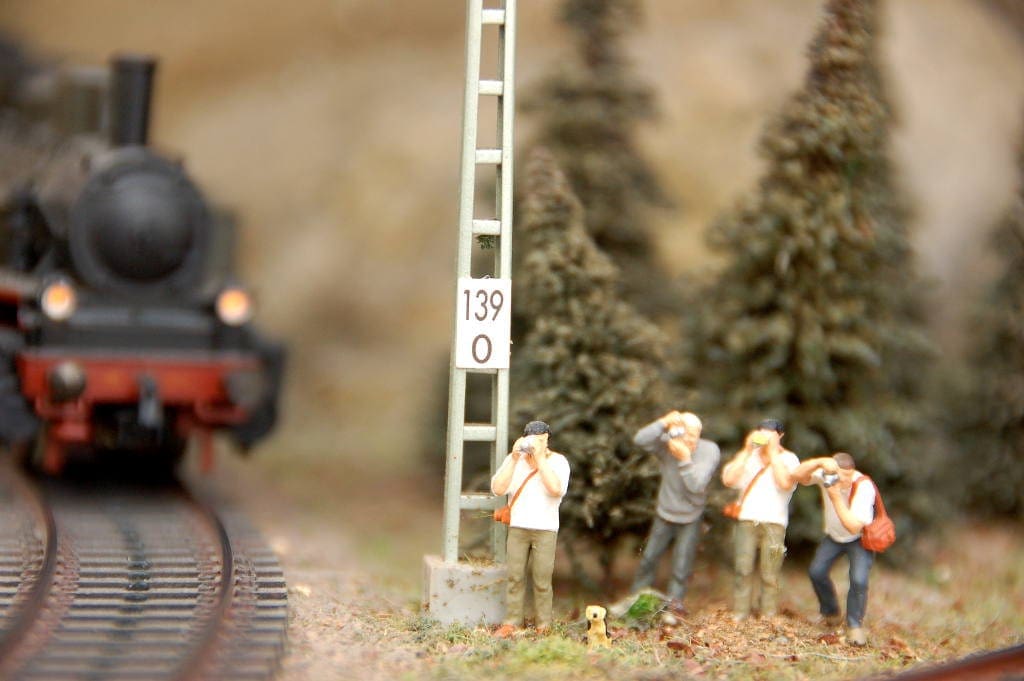
A black steam locomotive curves toward the camera with yellow headlights lit. Meanwhile, four small figures in white shirts and tan trousers stand trackside. They are holding cameras up. A white kilometer marker post reading “139 0” stands between the loco and the photographers. Dark conifers fill the right side of the frame.
This is a self-referential scene. It is a model railroad photographing model railroad photographers. The figures are well-placed in a believable cluster. They are all turned toward the train with cameras up. That posture sells the action. The kilometer marker is a small detail that confirms this is German prototype. A Marklin-style railfan figure set ranks among the most useful single accessory purchases for any catenary-era European layout.
7. Steam Loco With Green Passenger Coaches Past a Half-Timbered House
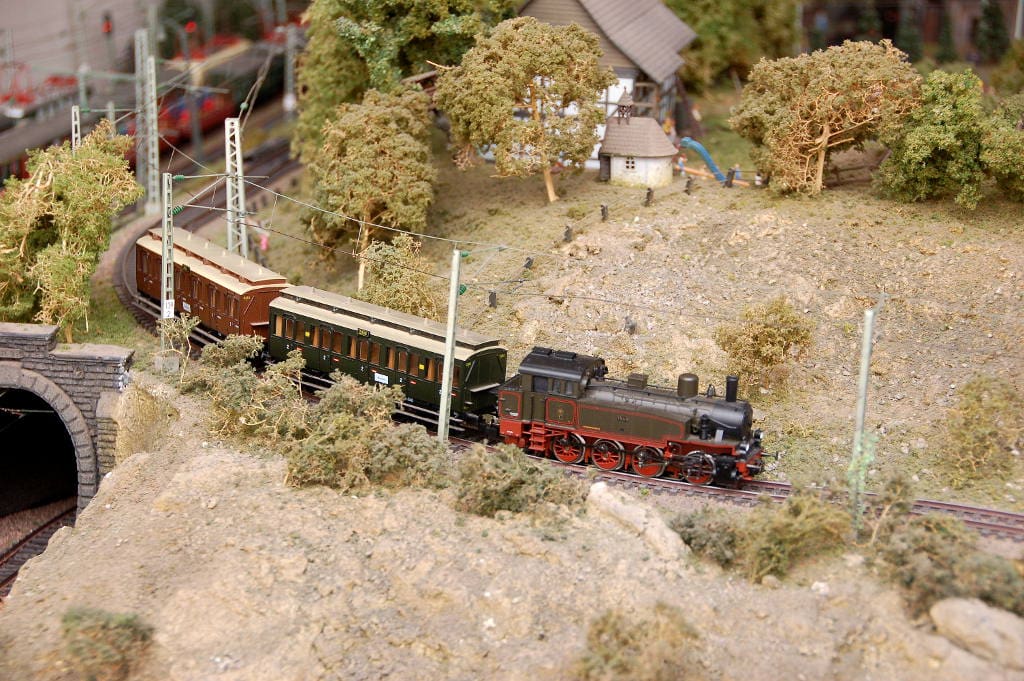
A Marklin steam tank loco pulls two dark green passenger coaches past a half-timbered country house. The house sits on a low rise. The track curves around the house. The foreground is dry yellow-green ground cover with scattered shrubs. A stone tunnel portal is just visible at the lower left edge.
This is the textbook Marklin passenger train scene. A steam-era tank loco threads through countryside with two short coaches. Ground cover variation is what makes it work. For example, yellow-green dried grasses sit in the foreground. Darker greens sit up near the house. There is also a clear transition between the cultivated yard and the wilder embankment below. A single shade of static grass across the entire foreground would have flattened the photo.
8. Half-Timbered House and Christmas Pine With Second House Behind
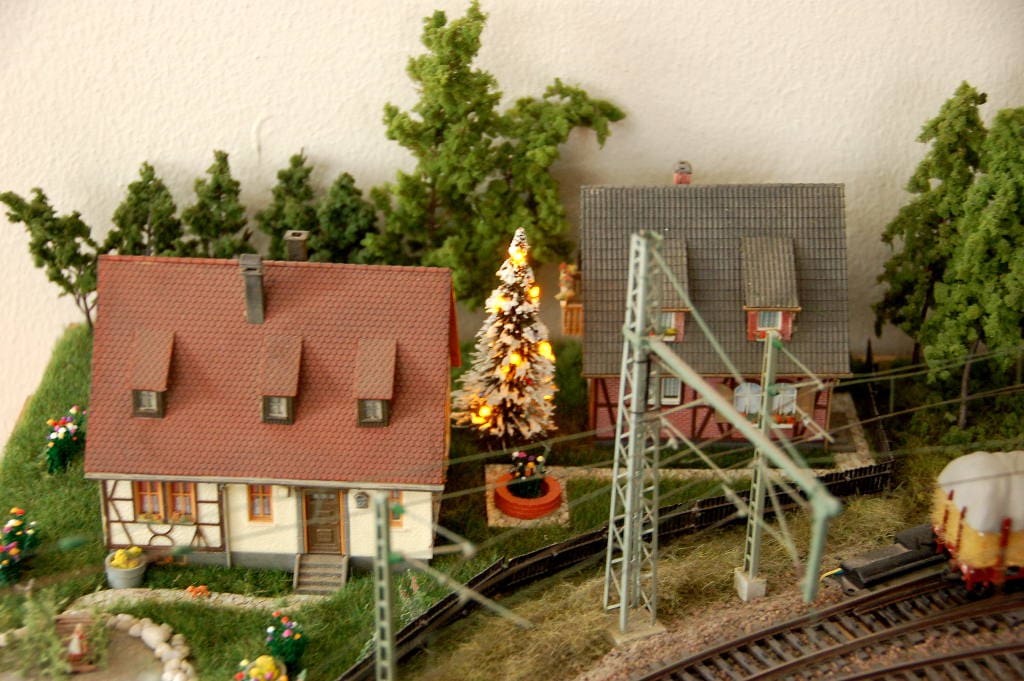
A Marklin half-timbered Bavarian house sits on the left. The roof is steep red tile. The chimney is brown. Meanwhile, a lit white Christmas pine on a circular base sits in the center of the frame. Then, a second house with a gray slate roof sits to the right. Surrounding trees are conifers in mixed greens. Small flowers line the front border.
The Christmas pine is a working lit accessory. It is also an easy upgrade for a German-outline village scene. The composition pairs two structures with deliberately different roof colors and styles. So the village reads as a real place rather than a catalog page. The flower border at the edge of the scene is a five-minute detail. It signals a cared-for garden and pulls the eye into the composition.
9. Overhead Engine Shed and Turntable Yard
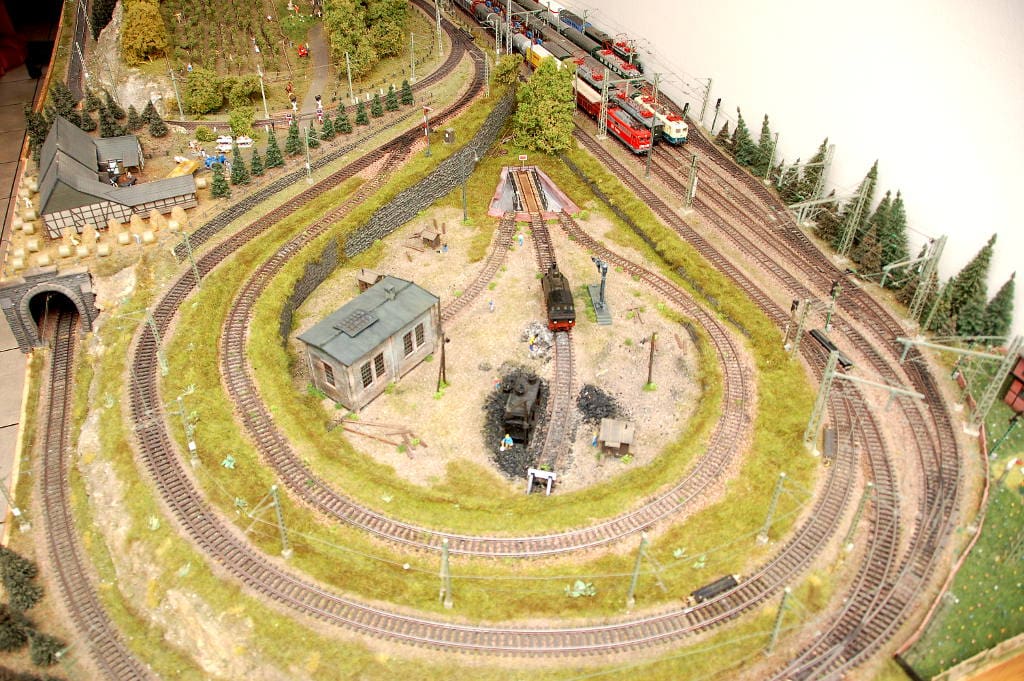
A high-angle shot looks down on the layout’s engine servicing area. A small wood engine shed sits in the foreground. Next to it, a working turntable pit positions a steam loco. Several stub tracks fan out around the pit. The mainline freight yard with red and yellow rolling stock is visible above. A tunnel portal sits at the far left. A Marklin platform with figures is just visible above the portal.
This is the operational heart of the layout. The turntable lets the steam fleet be turned. The stub tracks store engines between runs. The small shed handles light service. Put together, this area gets the most use during an operating session. The composition deliberately puts the operational center in the middle of the frame. Meanwhile, the freight yard reads as background activity, which is how the area actually functions during a session.
10. Three Flatcars With Tractor Loads and Passenger Coaches
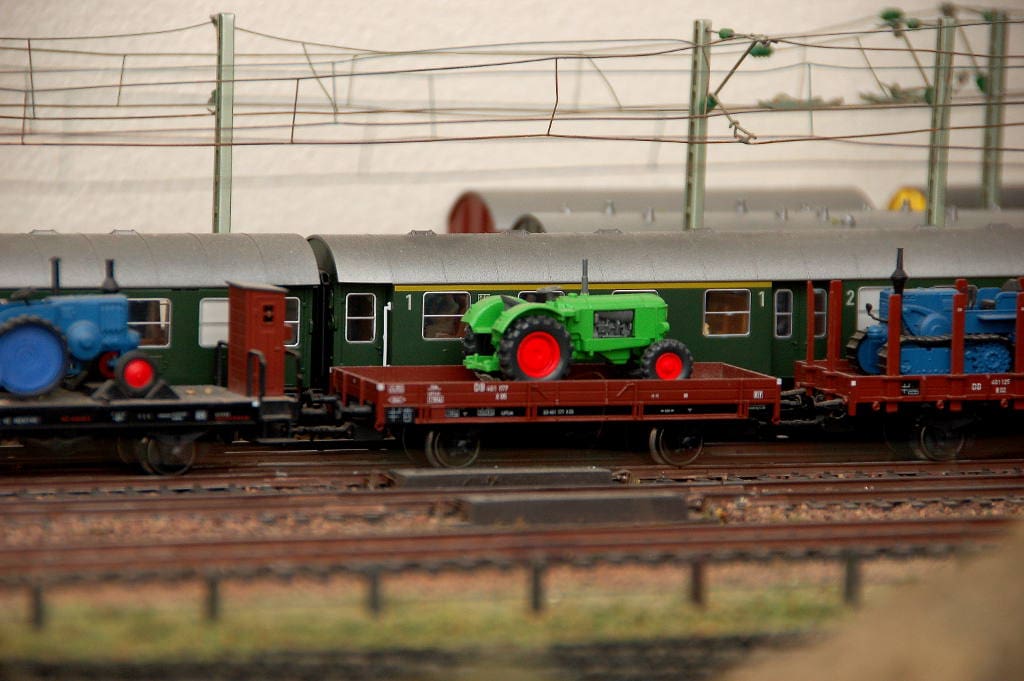
A side-on shot shows three short flatcars carrying tractor loads. The first carries a blue tractor with a red wheel hub. The second carries a green Deutz farm tractor with red wheels. A third flatcar sits in shadow. Behind them sit two dark green DB passenger coaches numbered “1” and “2.” The shot is composed at near eye-level. The camera looks straight across the rails.
Loaded flatcars are an easy way to add operational variety to a freight consist. You do not need more locomotives. For example, the tractor loads here are removable die-cast accessories. They sit on the flatcar deck and can be swapped out. So the same flatcars can run empty or with different loads on different operating sessions. The composition with the passenger coaches behind sells the scene as a working freight house next to a station platform.
11. DB Cargo Red Electric With Green Electric Loco
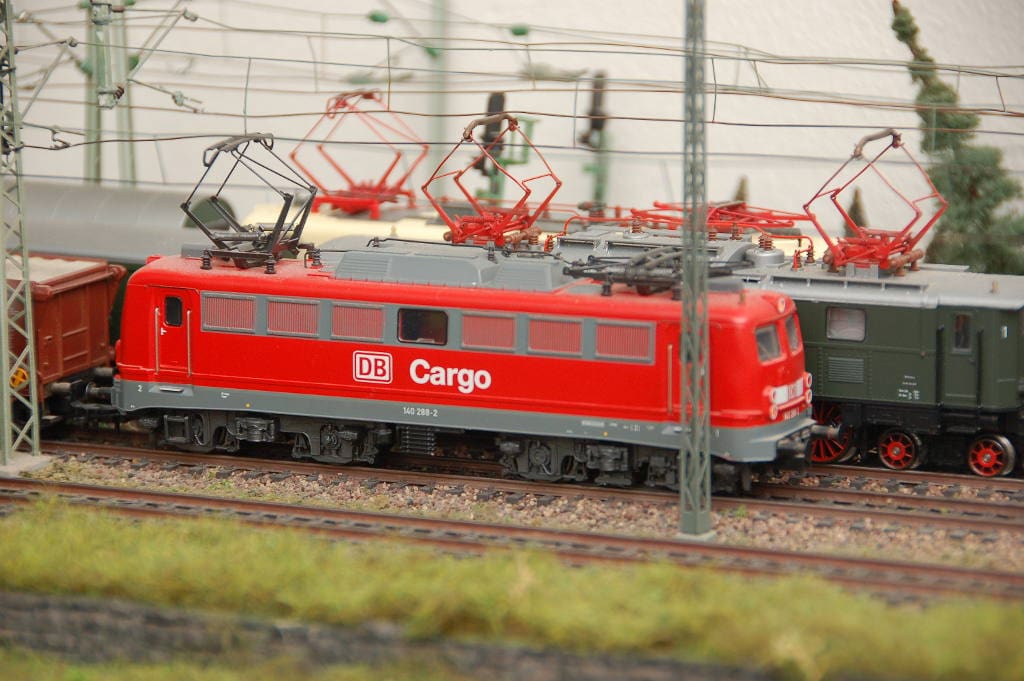
A modern Marklin DB Cargo class 140 electric sits parked on the track. The livery is red with white “DB Cargo” lettering. The reporting marks read “140 288-2.” Next to it sits a green Deutsche Bundesbahn electric. Both have red pantographs raised. Three sets of pantographs are visible against the white wall behind. Meanwhile, the foreground is dry green ground cover.
Two electrics in different liveries on parallel tracks is a useful way to date the layout. The red DB Cargo livery dates from 1994 onward. Meanwhile, the green DB livery is the earlier postwar period. Some modelers run mixed eras on purpose to show a rail museum or a heritage operation. Others stick strictly to a single era. Either way, the discipline is to make the choice on purpose rather than letting the roster drift over time.
12. Eva 100 Jahre Tank Car (Special Livery)
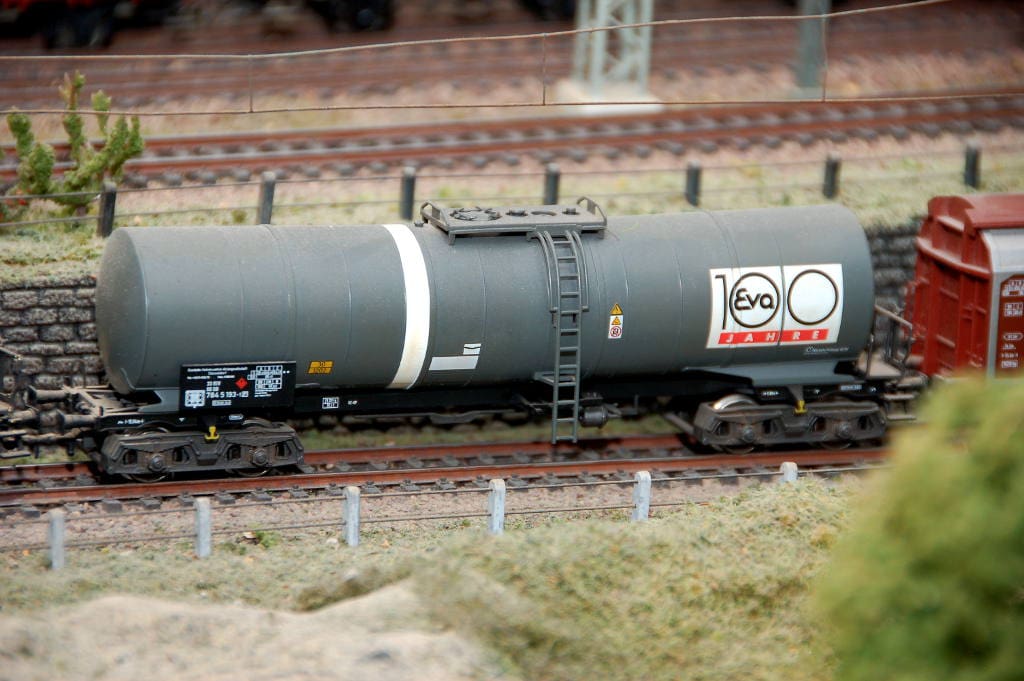
A grey Marklin tank car sits on a track between two other freight cars. The livery is special Eva “100 Jahre” centenary paint. The tank body shows reporting marks “7841 5193-123” and weather data. A red and white “100 Jahre Eva” logo sits centered on the side. A boxy red wagon is partly visible to the right.
Special-livery rolling stock counts as one of the few collectible elements on a Marklin layout. Eva ranks among the major German tank wagon leasing companies. Marklin produces these centenary and anniversary cars in limited runs. So the lesson for layout builders is to mix one or two standout cars into a freight consist for visual interest. Meanwhile, keep the bulk of the train in standard prototype liveries. That way, the special car reads as a special car.
13. Green E52 06 Electric Loco With Red Pantographs
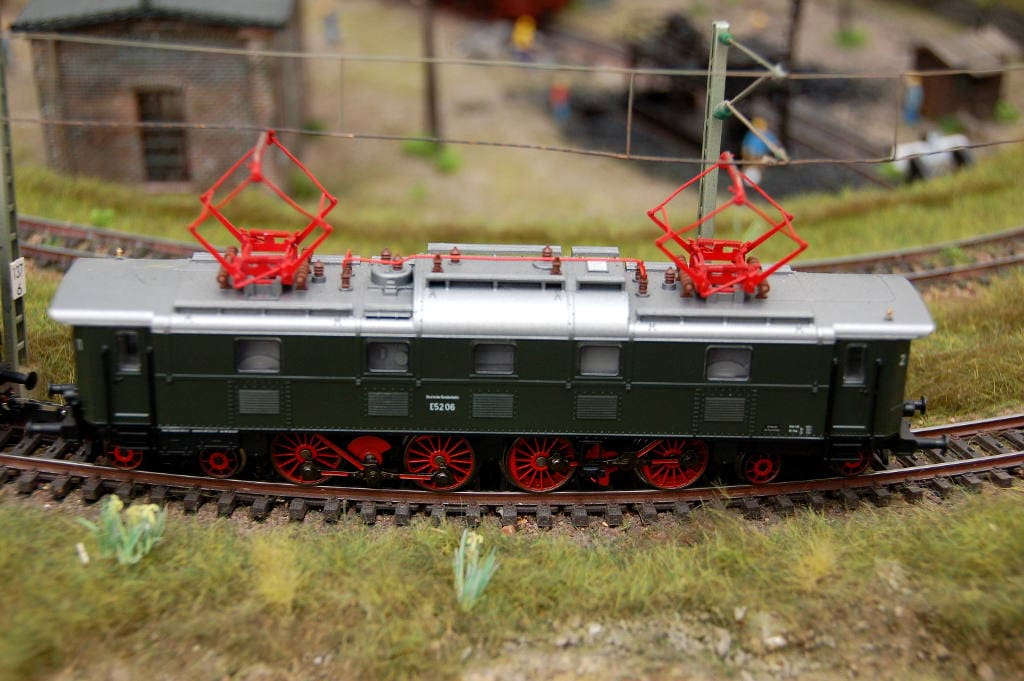
A green Deutsche Bundesbahn E52 06 electric loco sits on a single track. Both red diamond-shaped pantographs are raised against the catenary. The loco is a six-axle box-cab design. Red drivers are visible through the running gear. The surrounding scenery is summer grass. Small daisy or wildflower clumps sit in the foreground.
The E52 later became DB class 152. It is a classic Bavarian-prototype electric that fits the Marklin German-outline roster cleanly. The red diamond pantographs against the dark green body are visually striking. So the photo is composed to put both of them in the frame at full extension. Loco-only portraits like this one are useful for the gallery. They let the equipment carry the scene without competing with freight cars or scenery clutter.
14. Complete Overhead Room Shot of the Marklin Pike
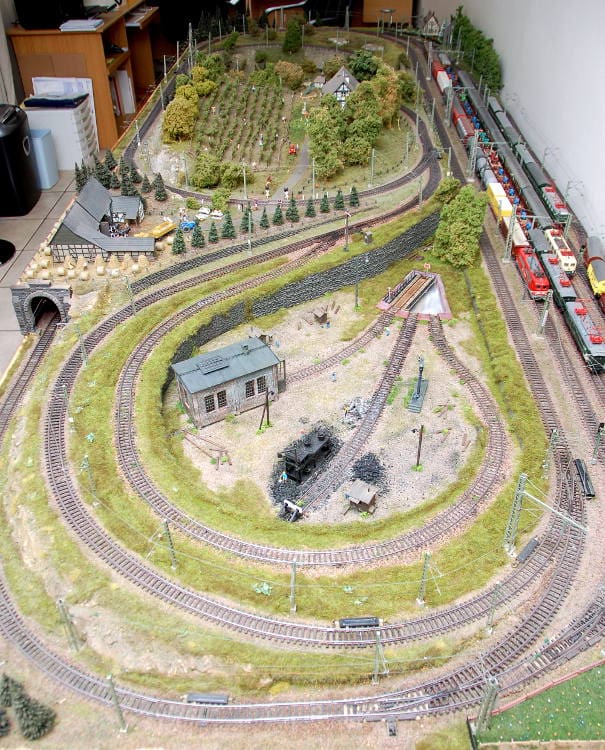
This is the full layout shot from a high corner of the operator’s room. You can see the room’s bookshelves. The layout fills the entire visible floor area. It is a large multi-level oval. The central engine servicing area sits in the middle. At one end, a curving hillside town holds the Christmas pine and small figures. A tunnel portal sits in the foreground. Meanwhile, the staging yard with red and brown freight cars sits on the right. Pine forests sweep along the back.
This is the kind of shot every layout builder eventually wants. Few actually take it. It requires getting the camera high enough to see the whole pike at once. So you usually need a stepladder and a tripod in a corner. The shot is worth the effort. It answers the one question every visitor asks: how big is this layout actually? Once you have a single overhead, every other photo on the pike has context. With that anchor, the gallery starts to read as a coherent place rather than a collection of unrelated scenes.
15. Real-Sound Running Footage Preview
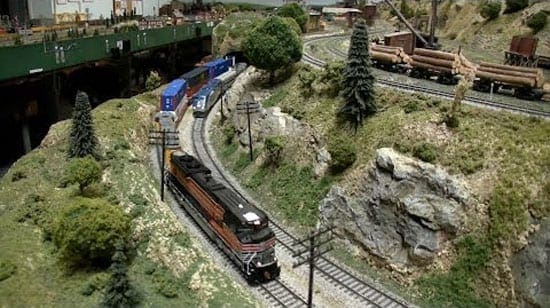
This is a second smaller layout preview. An HO American freight train threads past sandstone rocks. Pine trees and a small bridge sit in the background. This photo previews video footage of the layout running with prototypical real-sound DCC decoders. So it shows the modern upgrade most layout builders eventually move to.
Real-sound decoders cost two to three times what a standard DCC decoder does. However, the change in how a layout feels during an operating session is real. Steam locos chuff and whistle on grade. Diesels rev under load. Brakes squeal on stops. So when you build a Marklin layout from scratch in the modern era, buy locos with sound built in rather than retrofit them later.
Marklin HO Train Layout: Watch It Running
A short clip of the pike shows the catenary-wired mainline in action. A Marklin steam loco pulls a freight consist. Watch the loco enter and exit the stub tunnel portal. Then it threads through the village scene. Finally, it returns past the engine servicing yard.
Key Techniques From This Marklin HO Layout
Build the catenary first, then everything else
Every photo on this pike has wires in it. That is because the wires were planned into the trackplan from the start. Retrofitting catenary onto an existing layout is painful. For example, masts have to clear trains and wires have to stay tight. Rerouting around obstacles is also harder than getting it right the first time. So when building European outline, plan the catenary before you lay flex track.
Keep one era and one country, then commit to it
The DB Cargo red and the older DB green belong to one prototype railroad across about three decades. Nothing on this pike is American. Nothing is British. Nothing is modern high-speed. That discipline is what makes the village, rolling stock, signals, and scenery all read as the same place. A layout that mixes a Bavarian village with a Western American freight is two layouts pretending to be one.
Use the room for the overhead shot
The full-room photo is what turns a layout into a gallery-worthy pike. So climb up high in a corner and shoot the whole thing with even lighting. Then every other photo gets its context from that one shot.
Place figures where motion would actually happen
Look at where the figures sit on this pike. For instance, the photographers stand by the kilometer marker. The workers cluster at the coaling station. A hidden goat tucks into the rocks above the tunnel portal. All of them are placed where a real person or animal would actually be standing. Random figure placement reads as decoration. Motivated figure placement reads as life.
Getting Started on Your Own Marklin Pike
First, decide on era. You have a few options. Pre-electrification steam. The green-and-red DB transition era. The modern DB Cargo era. Or a museum-style mix of all three. That choice determines your roster, signals, structures, and scenery palette before you ever order track. Most builders who regret their layouts made the era choice late instead of early.
Next, build the catenary into your trackplan rather than treating it as an add-on. Both Marklin’s K-track and C-track support overhead catenary cleanly. Getting the mast spacing right at the planning stage saves hours of fiddling later. From there, work on disciplined scenery. Stick to one color family for terrain. Vary the trees and ground cover. Paint or curtain the backdrop. Finally, place figures in motion-implied poses. The model railroad scenery for beginners guide walks through these foundation techniques in detail.