HO scale western model railroads draw on one of the richest prototype eras in North American railroad history. The frontier West from 1870 to 1920 gives modelers access to narrow gauge mountain railroads, steam-era division points, and desert branch lines within a single historical period. If you are planning your scenery or working through a model railroad mountains build, western HO scale is one of the most scenic and well-supported prototypes available.
HO scale (1:87.1) is the most popular modeling scale in North America according to the NMRA, and the western prototype benefits from that popularity directly. Athearn, Bachmann, Walthers, and Atlas all produce period-accurate steam locomotives, narrow gauge equipment, and frontier structure kits for this era. The three layouts below cover a steam-era division point, a Colorado narrow gauge depot, and a desert Southwest branch line. Each one demonstrates a different technique you can apply to your own build.
Why Western Themes Work So Well in HO Scale
Western railroading from 1870 to 1920 is one of the best-documented eras in American railroad history. You have steam locomotives at their most varied: 4-4-0 Americans on flat desert lines, 2-8-0 Consolidations grinding up mountain grades, and 2-6-0 Moguls on branchline mixed freight. Frontier towns combine adobe stations, timber freight houses, and tall wooden water towers in arrangements you will not find in any other region or era.
The practical case for HO scale is straightforward. A 4×8-foot benchwork can fit a small frontier town, a steam servicing facility, and a mainline loop with a passing siding. That footprint is enough to run two trains, work several industries, and build convincing western terrain without dedicating a full room to the layout. The three layouts below show what is possible within that space when the focus stays on era-accurate scenery.
1. Steam-Era Western Model Railroad With Turntable
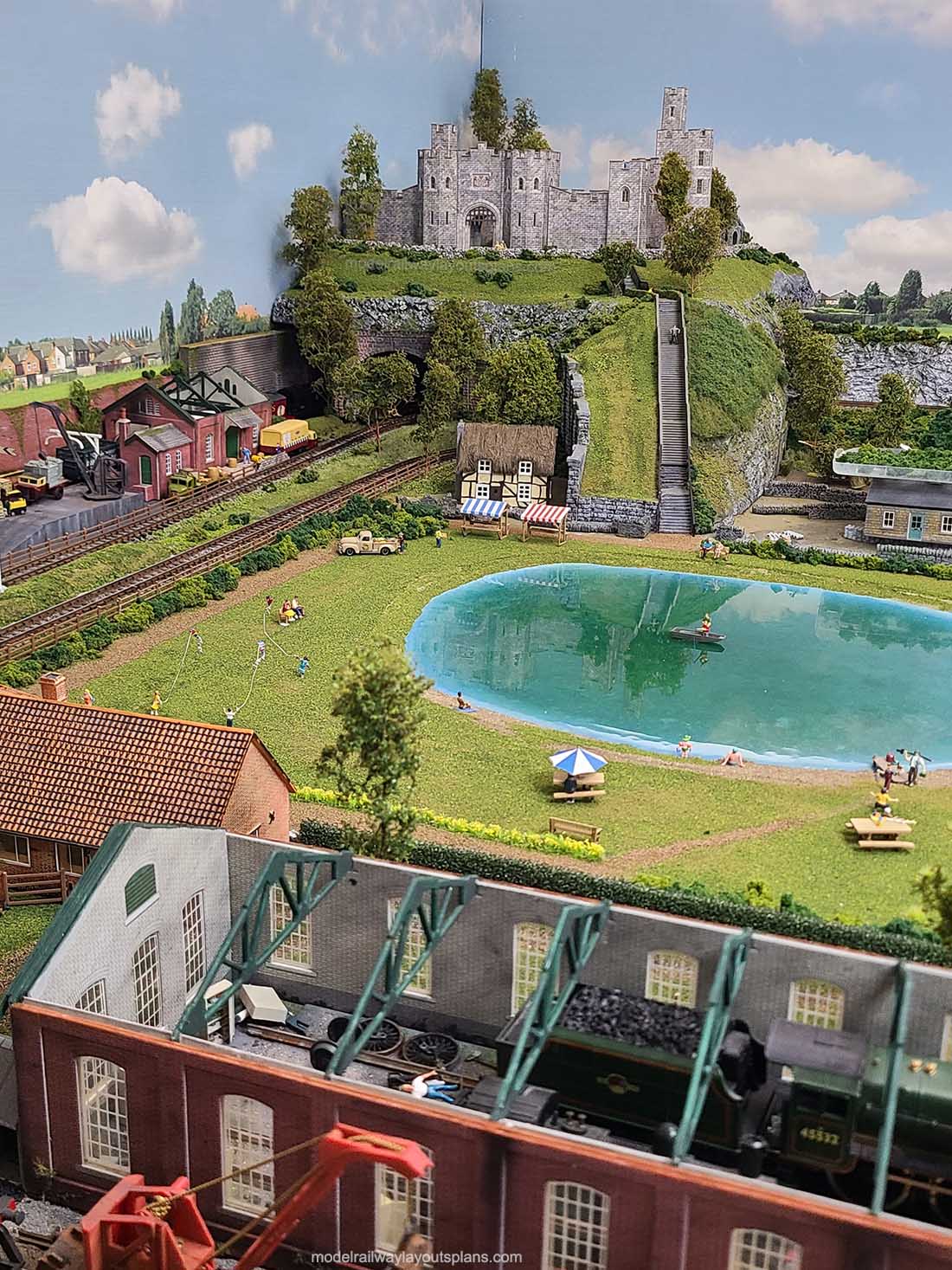
This layout models a 1890s Rocky Mountain division point in HO scale. The centerpiece is a working roundhouse with a functional turntable serving eight locomotive stalls. The roster includes 4-6-0 Ten-Wheelers and 2-8-0 Consolidations, both common power types on late-19th century mountain railroads in Colorado and Wyoming.
The weathering process here is worth replicating on your own steam fleet. Each locomotive starts with a base wash of Vallejo Dark Rust diluted to near-transparency, followed by layers of brown and black oil washes, sealed with matte varnish. Chalk powder goes on last at raised details to add dry grime deposits. This sequence builds rust streaks, oil stains, and road grime consistent with steam power that has been in mountain freight service for months.
The terrain uses raw umber as the base groundwork color throughout the entire layout. All timber structures are built from balsa soaked in India ink, which gives consistent aged-wood coloring without brush painting. Keeping one consistent color family across track ballast, groundwork, and structures is what gives this layout its visual unity. It is a discipline that is easy to describe and hard to maintain across a full build, and this layout executes it well.
2. Wild West Depot Scene With Narrow Gauge Detail
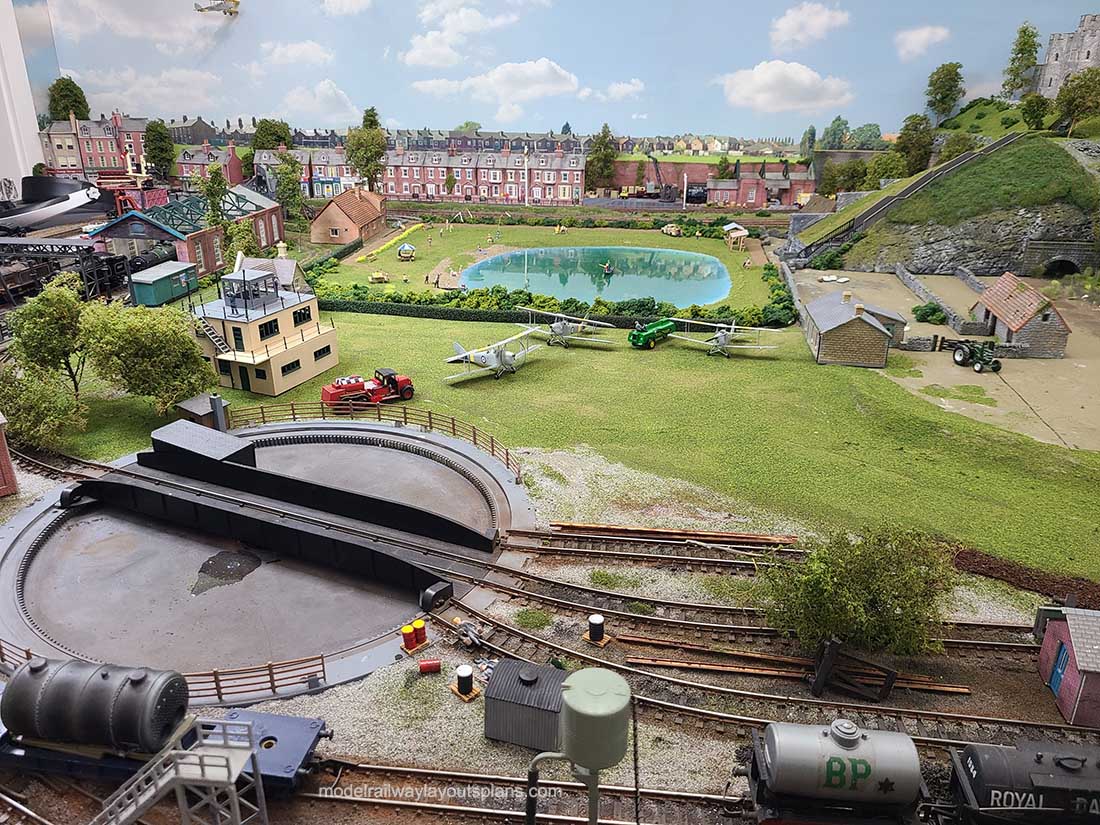
This layout models a Colorado narrow gauge mountain stop in HOn3 scale, which runs HO locomotives and rolling stock on 10.5mm gauge track to represent a 3-foot prototype gauge. That 6.5mm difference from standard HO track makes the cars and locomotives look noticeably smaller and more delicate against the terrain, which is accurate to railroads like the Denver and Rio Grande Western on their mountain branches circa 1875.
The three main structures are scratch-built. The freight house uses .020 sheet styrene scribed with a tool to represent board-and-batten siding, then stained with a diluted brown-black acrylic wash. The water tower is built from individually cut wood staves over a formed frame, a process that takes roughly eight hours. Both techniques take more time than assembling commercial kits, but the result reads as genuinely handmade rather than factory-produced.
Figures are placed at every functional location at eye level: cowboys near the hitching posts, mine workers at the hand truck, a telegraph operator visible through the depot window. This approach turns a static display into a scene that implies activity beyond the visible edges of the benchwork. For anyone building a large HO scale model railroad layout with a western narrow gauge branch, this scene shows how much character a small depot module can carry when every detail position is considered.
3. Wild West Model Train Layout With Desert Scenery
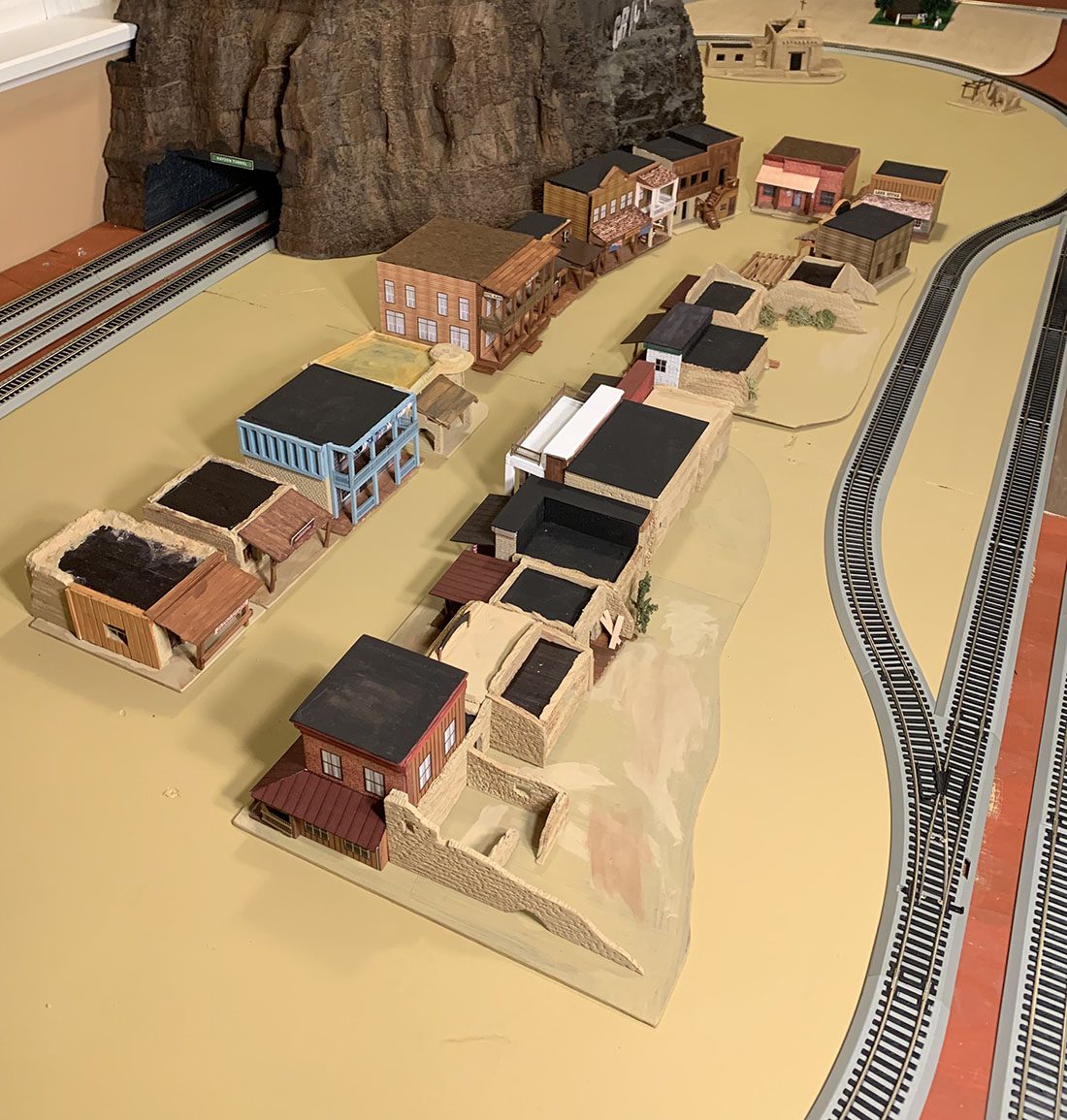
This layout represents an 1880s-1890s Arizona or New Mexico branch line in HO scale, referencing the desert lines run by the Atchison, Topeka and Santa Fe through the Southwest. The track plan is a single oval with one passing siding and a small yard. The simple plan is a deliberate choice: every hour not spent on complex trackwork goes into the scenery instead.
The red rock formations use a repeatable casting process. Mix hydrocal at 1.5 parts powder to 1 part water, pour into crumpled aluminum foil molds, and cure for 24 hours before sealing. Color goes on in three passes: a terracotta acrylic base coat, a burnt sienna wash at 4:1 water to paint, then a dry-brush of light ochre on the upper faces only. The foil molds create natural surface texture and the three-step coloring builds sandstone depth that no single-color approach can match. Woodland Scenics sells butte and mesa rock molds that produce consistent formation shapes if you prefer working from a defined form.
The color palette across the entire layout is restricted to burnt sienna, raw umber, and yellow ochre for terrain, with sparse sage green for vegetation. Keeping the palette this narrow is the single most important decision in desert western modeling. This layout is a direct example that a simple oval with consistent, well-executed terrain produces more visual impact than a complex track plan with underdeveloped scenery. The model railroad mountains guide on this site walks through the hydrocal and acrylic wash process step by step.
What Makes a Great Western Model Railroad Layout
Three things separate good western HO layouts from great ones.
Period accuracy
Western railroading covers at least four distinct eras: narrow gauge mining railroads of the 1870s, transcontinental mainlines of the 1880s, the early transition to larger steam in the 1900s to 1920s, and the diesel transition of the 1940s to 1950s. Picking one era and applying it consistently to your equipment, structures, and figures makes the layout read as a coherent scene. Mixed-era layouts are easy to spot and they undermine the credibility of even excellent scenery work.
Terrain matched to the prototype
The American West covers several distinct biomes and each requires different materials and color palettes. Desert Southwest layouts need warm earth tones, sparse vegetation, and sedimentary rock formations. Mountain layouts need cooler greens, conifer trees, and igneous rock textures. Mixing the two without a geographic rationale creates layouts that look generic rather than specific to a place. Decide where your layout is set geographically before you buy any scenery materials.
Period-correct steam power
The locomotive is what viewers look at first on any western layout. A correct 2-8-0 Consolidation or 4-6-0 Ten-Wheeler weathered to match mountain service conditions sets the era before a viewer reads a single sign or building. An unweathered or incorrect model undercuts the entire layout regardless of how good the surrounding scenery is. Get the power right and weather it appropriately for the service conditions your layout implies.
Key Elements of Western Railroad Scenery
Earth tones, not green. Western prototypes from the desert Southwest and Great Plains have far less vegetation than Eastern or Midwestern layouts. Use raw umber, burnt sienna, and tan as primary groundwork colors. Add vegetation sparingly. Overusing green blended turf is the most consistent mistake on western HO layouts, and it reads as wrong immediately against any reference photograph.
Hydrocal castings for desert rock. Sedimentary mesa and butte formations look structurally different from the folded igneous rock of eastern mountains. Hydrocal castings from rock molds capture the flat, layered character of desert formations better than carved foam for this specific terrain type.
Adobe and timber for structures, not brick. Desert Southwest frontier structures were adobe or wood-frame. Mountain frontier structures were rough-sawn timber. Brick and cast iron commercial facades are an Eastern and Midwestern building type. Using them on a western layout breaks the visual logic of the scene for anyone familiar with the prototype.
Painted backdrop distance. Paint distant mountains, mesa tops, or a dust haze at the horizon line. A flat blue sky makes even a well-built layout look unfinished. Three to four hours of backdrop painting adds more apparent depth to a small layout than any physical scenic addition of comparable effort.
Getting Started With Your Western HO Scale Layout
Start with prototype research before purchasing equipment. Pick one railroad and one decade. The Denver and Rio Grande Western narrow gauge lines in Colorado are well-documented and have strong manufacturer support from Bachmann, Blackstone Models, and others. The Atchison, Topeka and Santa Fe desert lines have extensive photographic records from the 1880s to 1900s. The NMRA reference library at nmra.org lists prototype resources organized by railroad and era.
Once you have a prototype, build the simplest track plan that gives you the operations you want. A 4×8-foot single oval with two or three industries is a complete layout for a western branch line. The time saved on a simple track plan should go directly into scenery. All three layouts above use uncomplicated track plans and the scenery is what makes them stand out. Our scenery track planning guide covers how to approach layout design when the scenic goal comes before the track plan.