If you’re shopping for N scale train sets, the choice comes down to the brand, the control system and how much tabletop space you can spare. Each box holds a locomotive, a few cars, a loop of track and something to power it. That’s why these sets are the fastest way into the smallest popular model railroad scale, and you can run a train the day it arrives.
Kato and Bachmann both sell complete boxes, and the seven below come from their own catalogs. This guide to N scale train sets is about the sets rather than the layouts. It covers what is in each box, which control system it uses and how much table it takes. When you’re ready to decide what to build next, the links point to our layout pages.
What comes in a box of N scale train sets
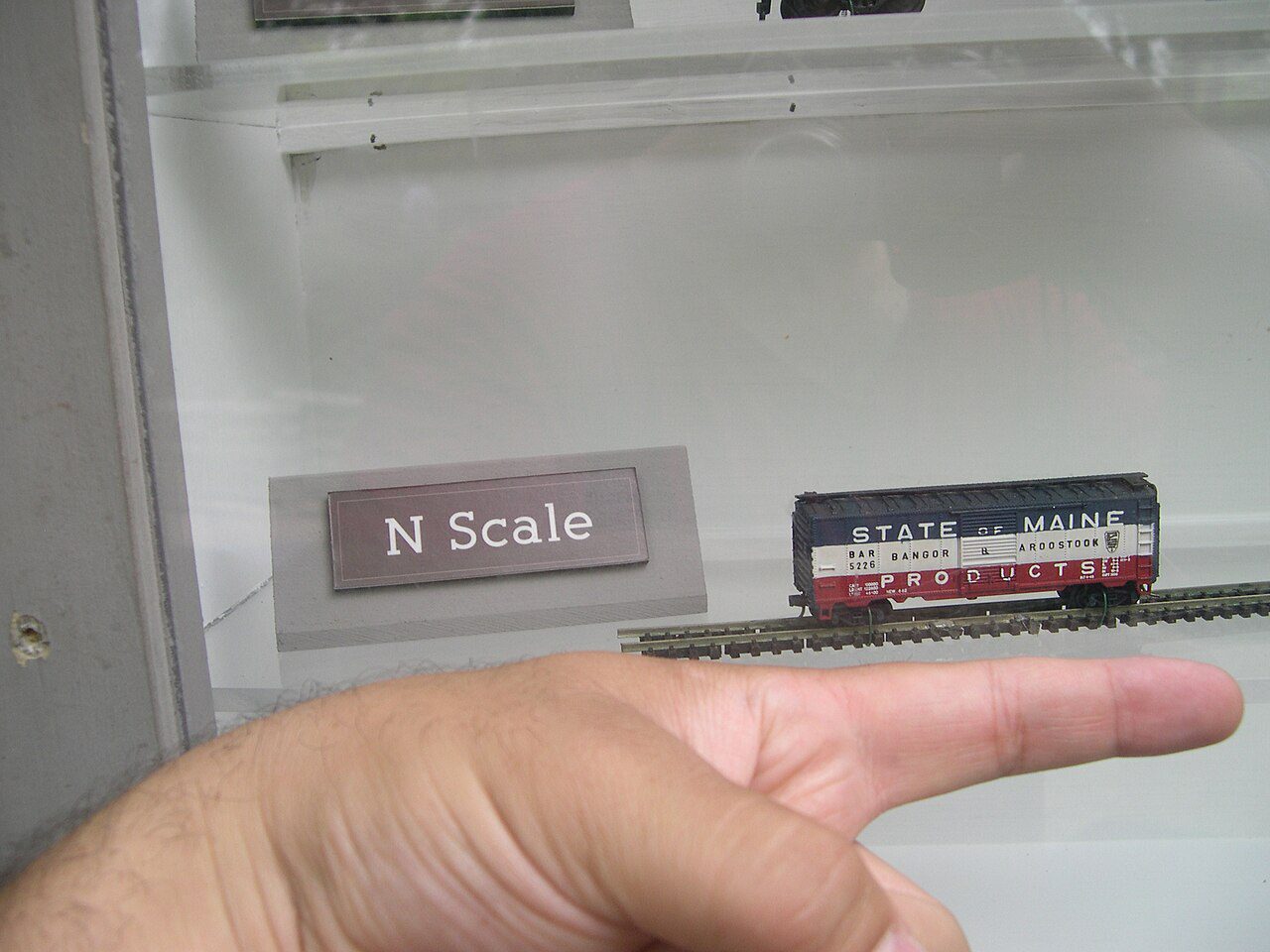
Every starter set follows the same recipe of one locomotive, some freight or passenger cars, a loop of snap-together track, a rerailer and a controller. That means you can compare boxes mostly by their cars and their power. N is 1:160 scale, so a whole oval fits on a table. Bachmann puts a typical railcar at about 4 inches long and three quarters of an inch wide.
The car count changes from box to box, so check it before you purchase. Kato’s Starter Guide lists one locomotive and three cars for its basic package. The Gevo box lists six cars and the F7 box lists four, while Bachmann’s boxes run from three cars to eight. If you want a longer train, read the car list instead of assuming from the brand.
DC or DCC in N scale train sets
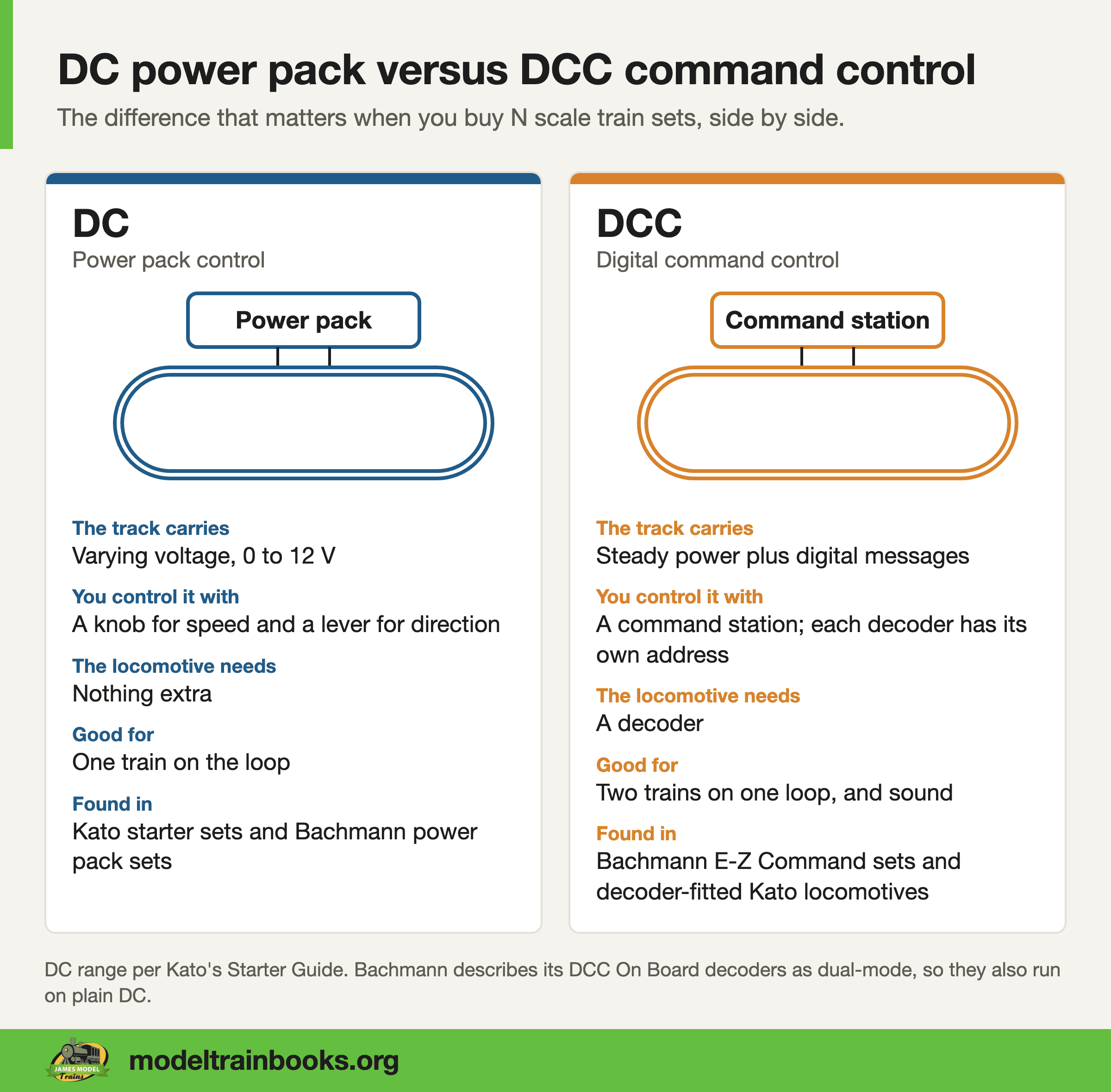
Most starter sets run on DC, where a power pack feeds the rails between 0 and 12 volts, per Kato’s guide. The knob sets speed and a lever sets direction, so it’s a straightforward system that’s sufficient for one train.
DCC works differently because it keeps full power on the rails and sends digital messages instead. A decoder inside each locomotive listens for its own address, which lets two trains share one loop and is also how sound works. The catch is that the locomotive needs a decoder, although Bachmann describes its DCC On Board line as a dual-mode decoder that runs on plain DC as well.
Kato Unitrack handles both DC and DCC, so a DC start doesn’t lock you out of DCC later. Kato lists its Gevo as a drop-in fit for several decoders. That locomotive also comes from Kato with DCC, or DCC plus sound, already installed, so you can skip the fitting if you’d rather. Whichever system you pick, the track is the next thing to compare, because the two brands build it differently.
Kato Unitrack versus Bachmann E-Z Track
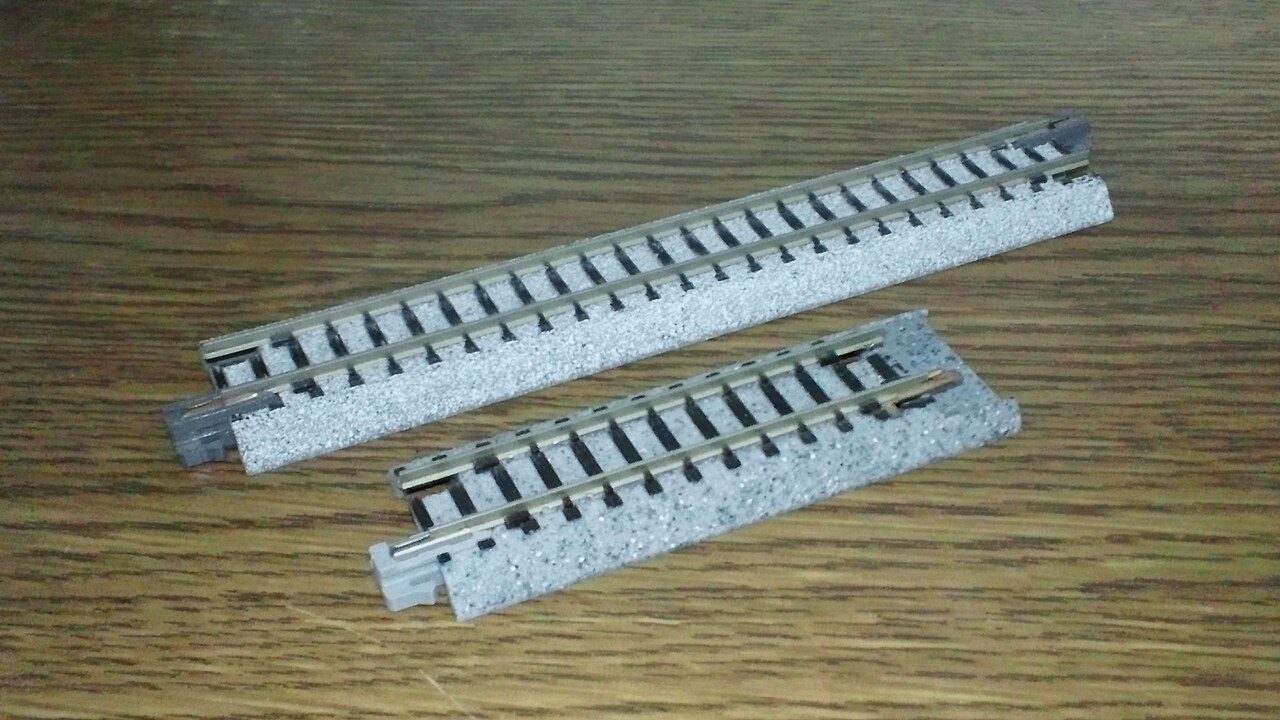
Kato N scale train sets ship with Unitrack, and Bachmann N scale train sets ship with E-Z Track. Both are snap-together track with the roadbed attached, so neither needs glue or nails. The real difference is geometry. A Kato starter oval uses eight 45-degree curves with a 315 mm radius, which is 12 3/8 inches, while a Bachmann circle uses 11.25 inch radius pieces that cover 30 degrees each.
The Bachmann curve is about an inch tighter in radius, so its loop is about two and a quarter inches narrower. That matters because tight curves make long cars swing wide at the ends. If you’d like more clearance for them, Kato sells wider starter loops too. Its Starter Guide shows R282, R315 and R348 ovals, and Unitrack curves run from R117 to R718.
Both brands sell number 4 and number 6 turnouts for later, so the first loop doesn’t have to be the last one. If you want a full list of what Bachmann makes in this system, see our page on Bachmann E-Z Track layouts. Track geometry sets how much table you need, and that’s the next question.
How much room N scale train sets need
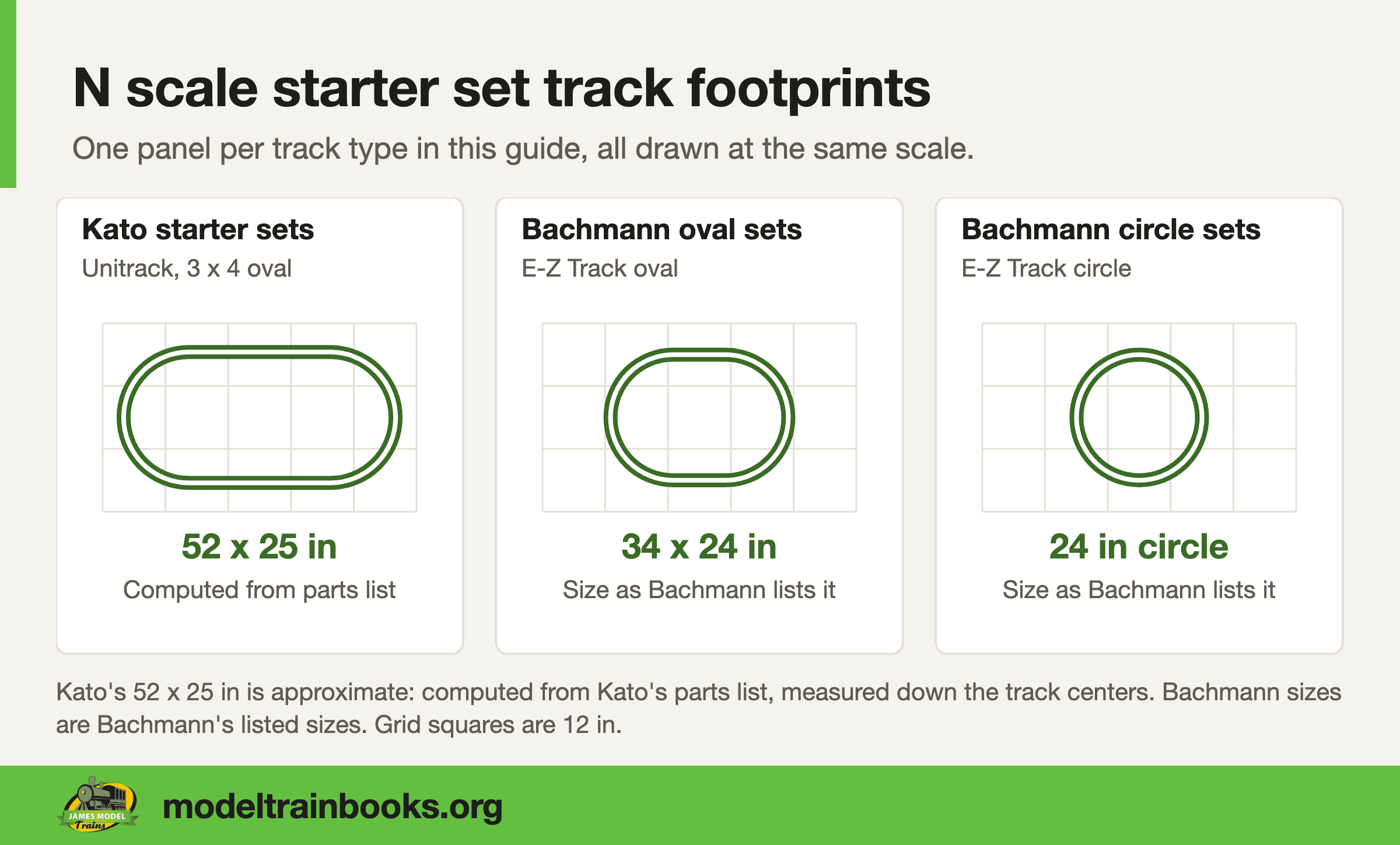
The room an N scale train set needs is the loop plus space to reach in. The Kato oval adds up to about 52 by 25 inches, measured down the track centers from the parts in the box, and Kato calls it a 3 x 4 oval. Bachmann lists its ovals at 34 by 24 inches and its circle sets at 24 by 24, so measure your table before you pick a brand.
That means a Kato set wants a table about 2 by 4 feet, while the Bachmann circle fits on a 2 foot square. Leave a few additional inches for the controller and for your hands, since you have to reach the track. If you have a spare shelf or desk, our small N scale train layouts show what fits in that space.
Kato ES44AC Gevo Mixed Freight Starter Set
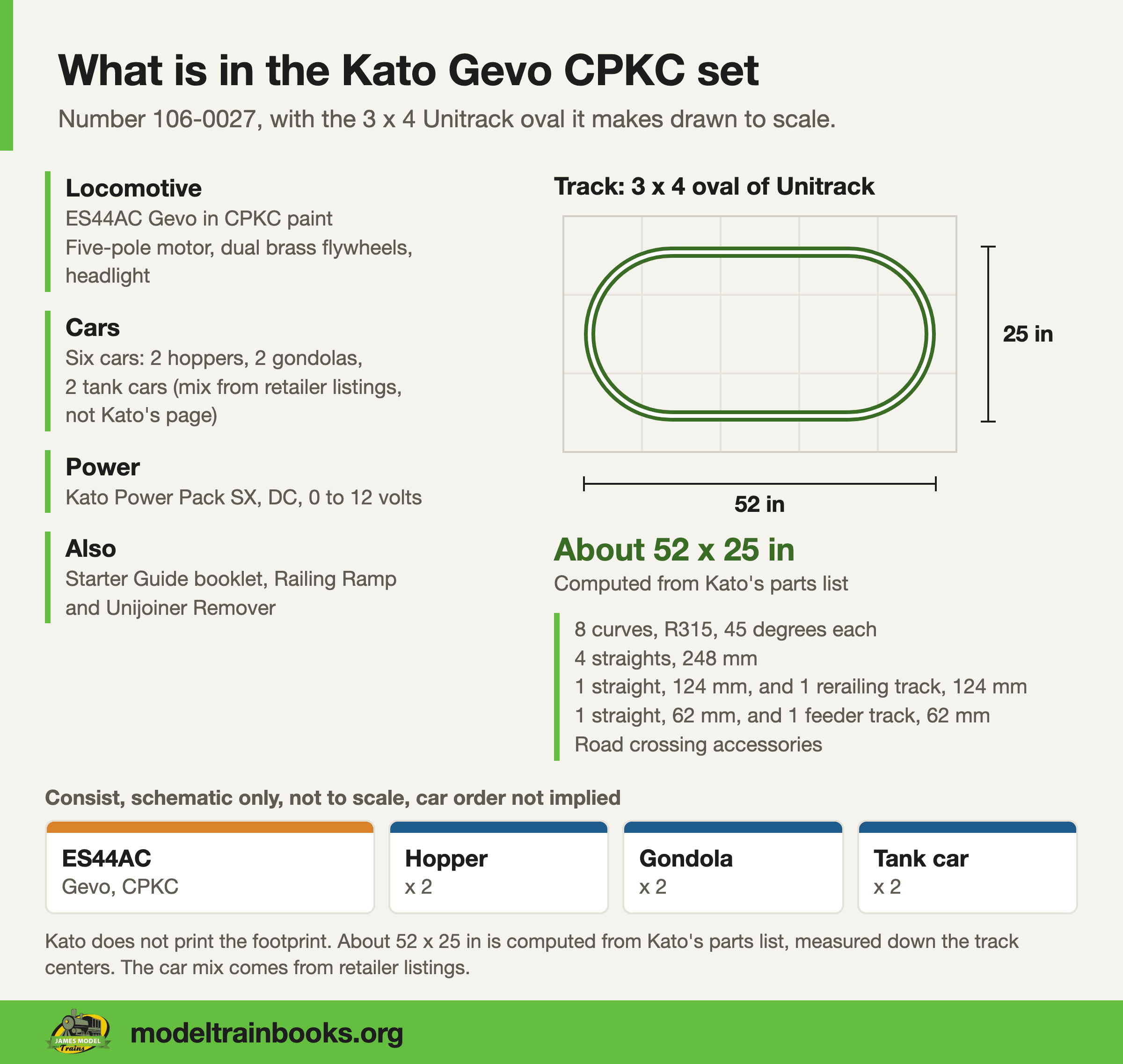
Of the Kato N scale train sets, the Gevo is the one to pick if you like modern freight. The CPKC version, number 106-0027, pairs an ES44AC Gevo with six cars, which retailer listings put at two hoppers, two gondolas and two tank cars. The track is a 3 x 4 oval of Unitrack with a feeder, a road crossing and a rerailing section. A Power Pack SX comes in the box, so you don’t need to purchase anything else to operate it. Kato sells the same box in other schemes, including BNSF (106-0024), CSX (106-0021) and Florida East Coast (106-0026), so you can choose by paint.
It suits a buyer who wants room to grow, because the Gevo has a five-pole motor with dual brass flywheels and a directional headlight. Kato lists it as a drop-in fit for the TCS K1D4, the Digitrax DN163K1C and the ESU 58741 LokSound 5 micro decoders. That means a later move to DCC doesn’t require swapping locomotives. When the oval feels small, our complete N scale train layouts page shows where it can go.
Beginners Guide to Model Trains
Starting your first layout? Build from plans that already work.
James Reynolds has built layouts for over 27 years, and his guide puts the plans, the trackwork method and the wiring basics in one place so you skip the costly first mistakes.
- Beginner track plans you can build right away, including loops, figure eights, dog bones and tabletop plans for small spaces.
- A step-by-step trackwork method that helps you avoid derailments and erratic stops.
- A plain-English DC versus DCC guide, plus the five mistakes that most often stall a first layout.
$47 today. The price includes 30 days of free access to the James Model Trains member club, then $27 a month until you cancel. Every purchase carries a 60-day money-back guarantee.
Kato F7 Freight Train Starter Set in Santa Fe Paint
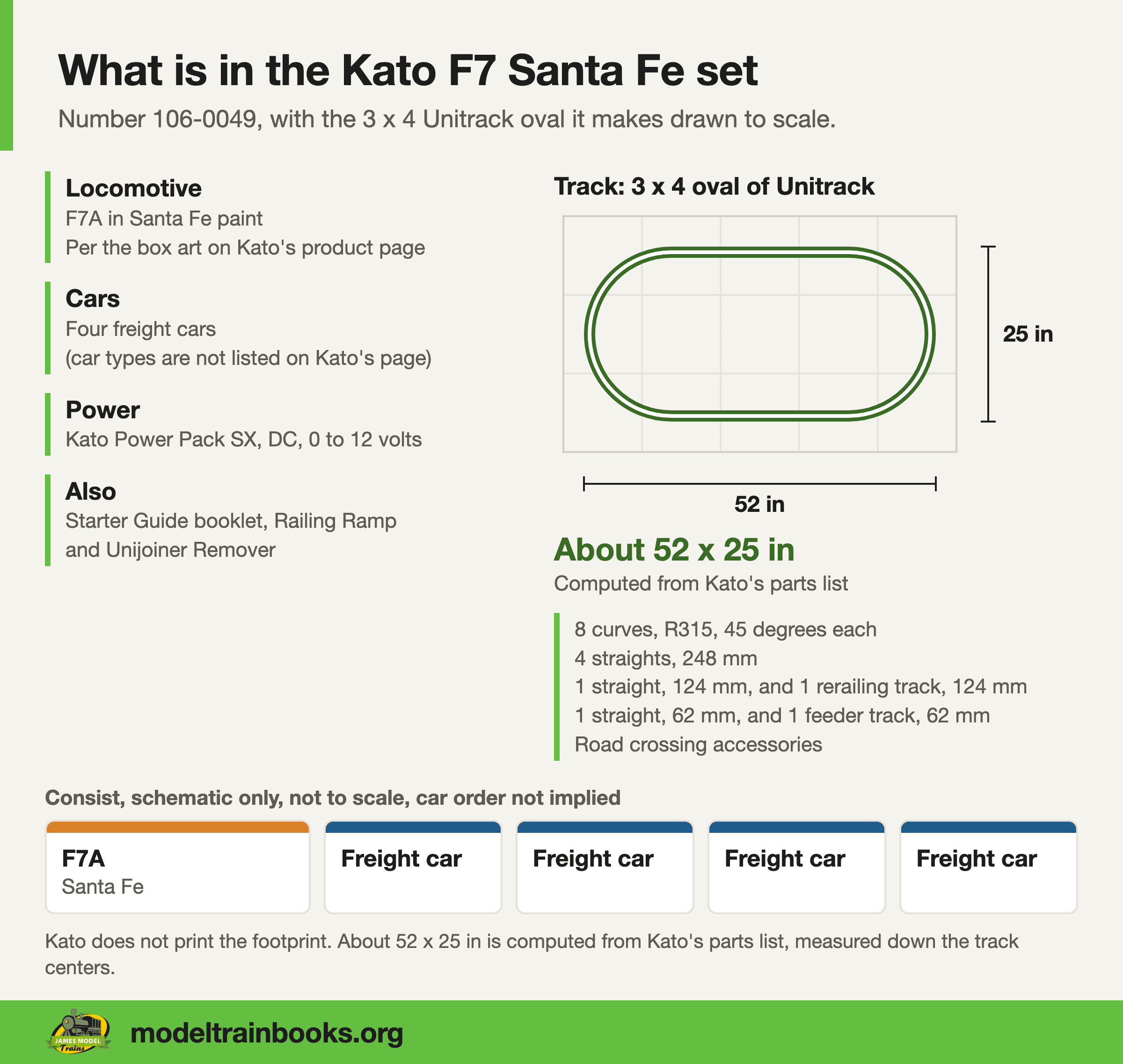
The F7 set, number 106-0049, swaps the modern Gevo for a classic cab unit, so it’s the Kato choice if you like the look of the 1950s. Kato’s box art lists an F7A and four freight cars, and the track and controller match the Gevo set. That means you get the same 3 x 4 oval and Power Pack SX. Kato lists Union Pacific (106-0050) and Santa Fe Bluebonnet (106-0051) versions, so there’s more than one paint scheme to choose from.
The red and silver Santa Fe paint is one of the most recognized in the hobby. It shows, too, that shopping for N scale train sets is mostly about personal taste. The motor and track are the same as the modern set, and only the locomotive and the cars change. If you’d rather ride in a passenger train, the next Kato set is the Super Chief.
Kato Santa Fe Super Chief Starter Set
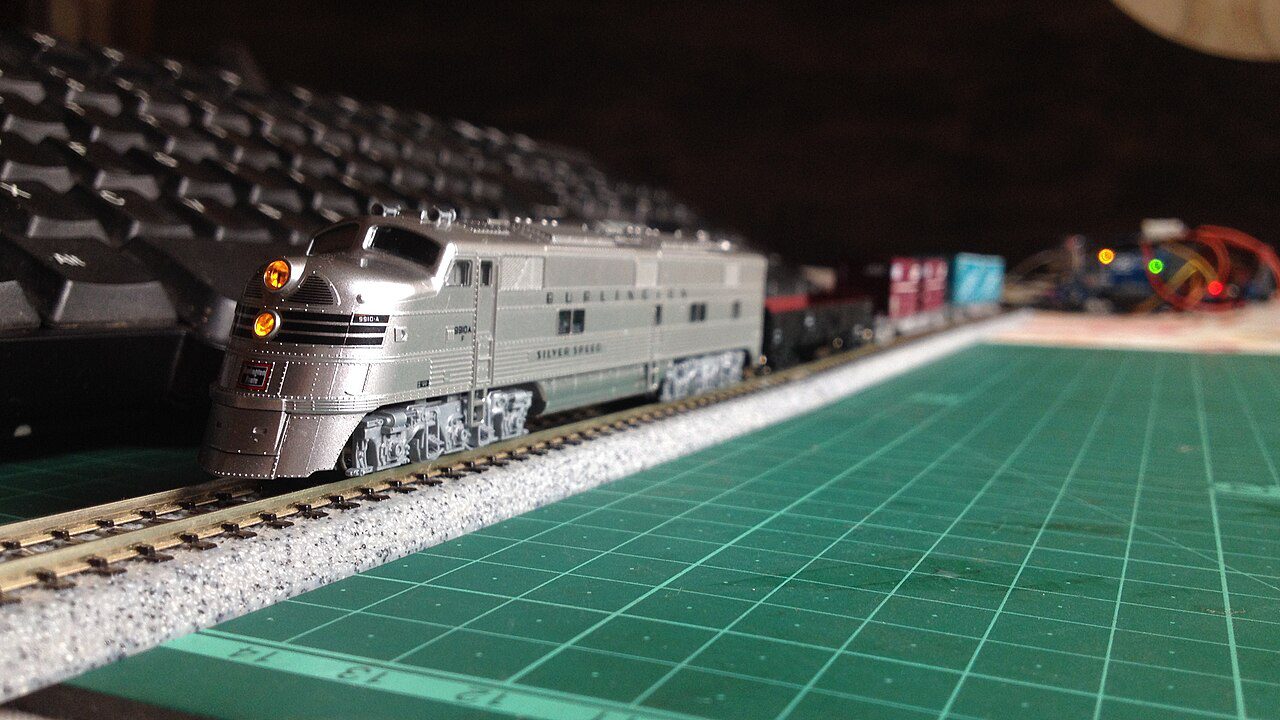
The Super Chief set, number 106-0018, is Kato’s passenger starter, and Kato describes it as a classic Santa Fe mini-Chief. It uses the same Unitrack oval and Power Pack SX as the freight sets, so the table space doesn’t change. Kato’s page does not list the car count, so check the box before you commit. The photo above shows a different Kato streamlined locomotive, not this set.
Passenger cars are longer than freight cars, so they look best on wide curves. The 12 3/8 inch radius works, though a wider oval is more forgiving of long cars, so Kato’s wider starter loops are worth a look. For a modern look, Kato’s Amtrak ALC-42 and Viewliner II set, number 106-0047, uses the same track and controller. If you’d rather have a Bachmann set that fits on a desk, the next block covers the smallest one.
Bachmann Thunder Valley
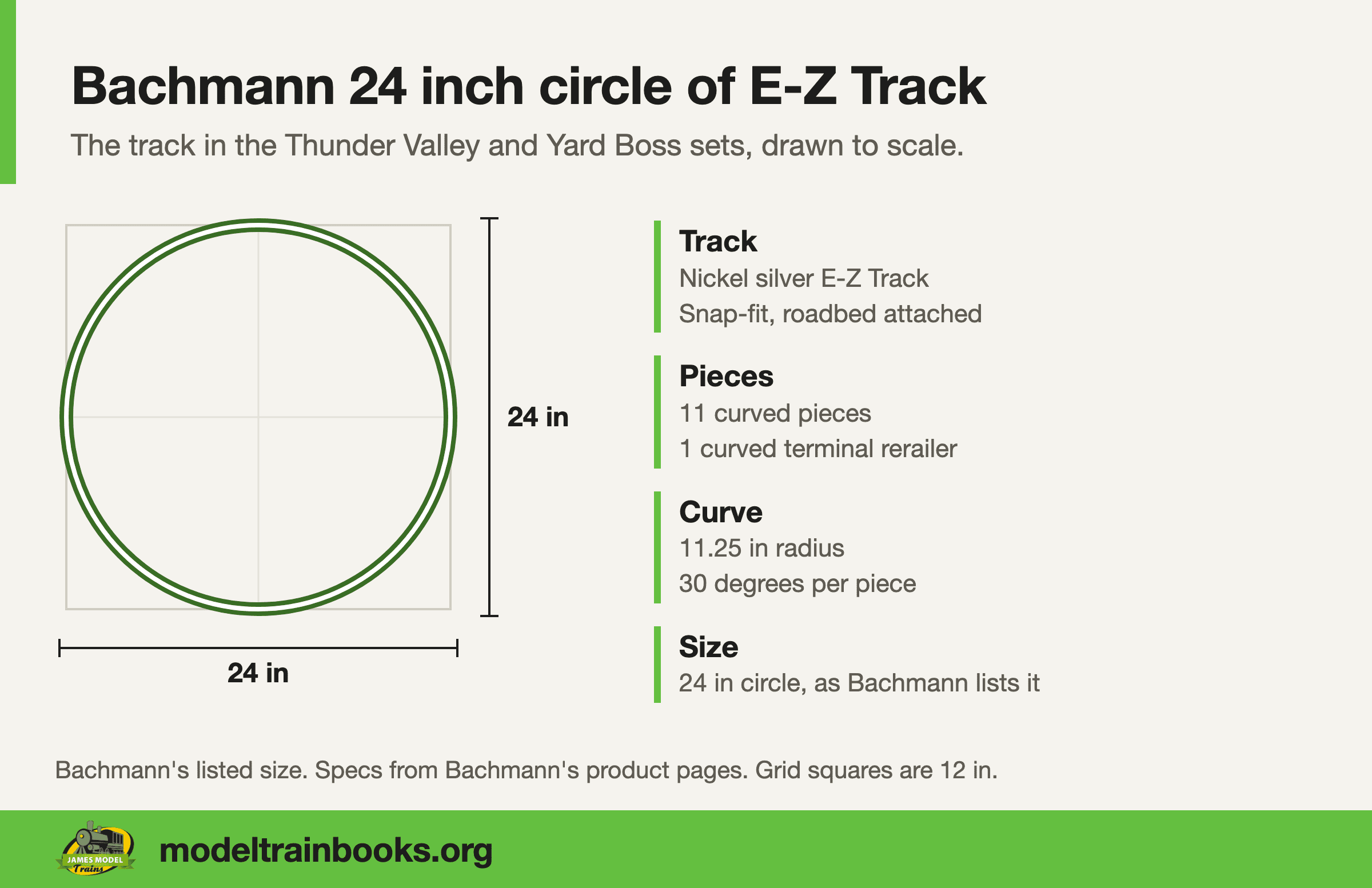
Thunder Valley, number 24013, is the most compact of the Bachmann N scale train sets here. That makes it the one to look at if table space is your limit. The box holds an EMD GP40 with a working headlight, a 50 foot steel reefer, a three-dome tank car and a 36 foot wide-vision caboose. The track is a 24 inch circle of nickel silver E-Z Track, with 11 curved pieces and one plug-in terminal rerailer, and a power pack and speed controller come in the box.
Because the circle fits on a 2 foot square, this is a desk or shelf set. The price of that size is the 11.25 inch curve, and long cars look cramped on it. If you prefer steam, Bachmann’s Yard Boss, number 24014, uses the same 24 inch circle with a USRA 0-6-0, a boxcar, a quad hopper and a caboose. If you have room for an oval, the Freightmaster comes next.
Bachmann Freightmaster
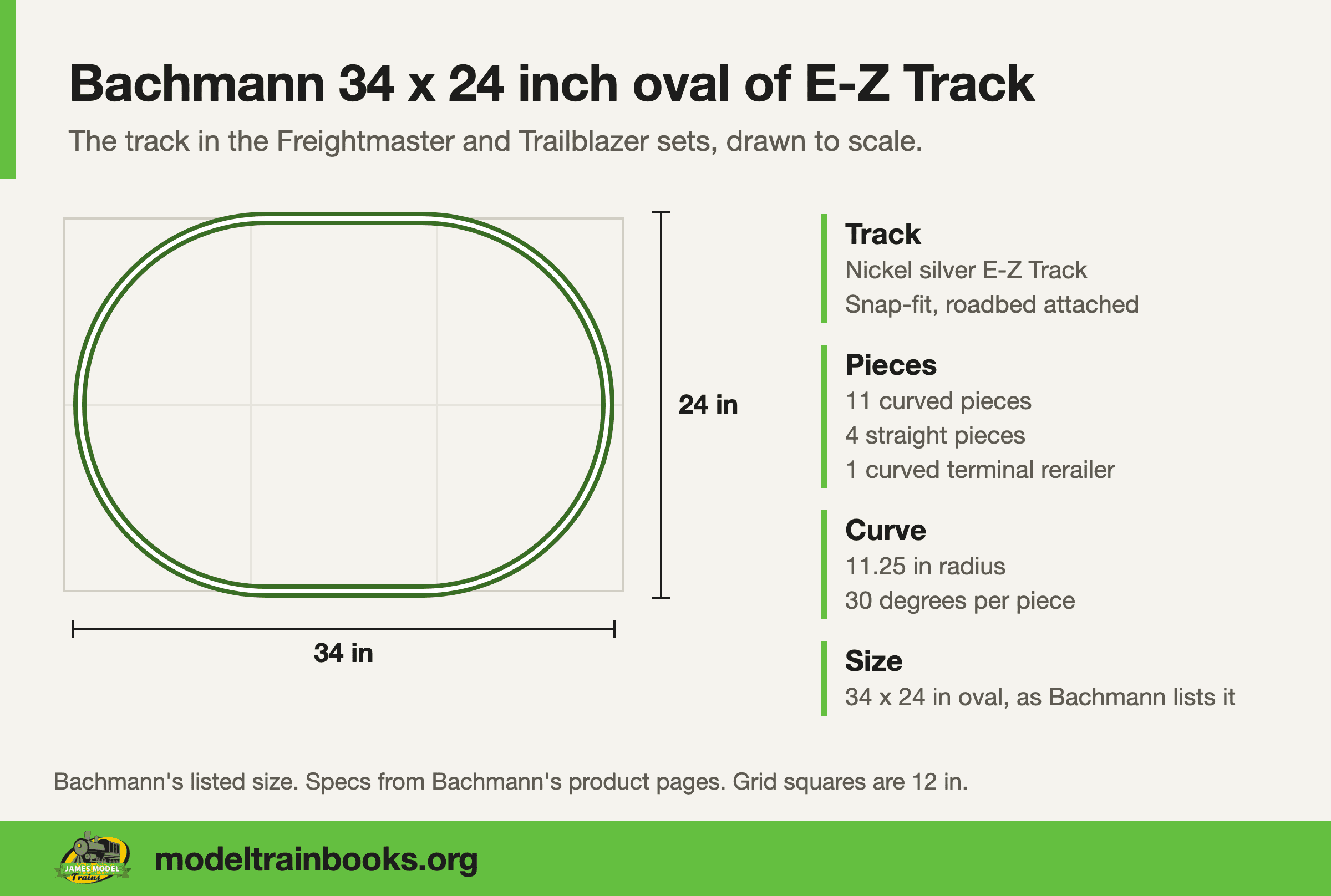
Freightmaster, number 24022, is Bachmann’s CSX freight box, built around a GP40 with a headlight. The rest of the train is a 52 foot flatcar with a container, a 40 foot gondola with a removable coal load, a 50 foot plug-door boxcar and a caboose. The 34 by 24 inch oval has 11 curved pieces, 4 straights and one curved terminal rerailer.
Among Bachmann N scale train sets, the accessories set this one apart, because you get a fully assembled freight station, 24 railroad and street signs and 12 telephone poles. That gives a beginner something to place alongside the track on day one. It suits the buyer who wants a small scene rather than just a train going in circles. The straights on each side of the oval are where the station goes. If you’d rather run steam than diesel, the Trailblazer uses the same oval.
Bachmann Trailblazer
Trailblazer, number 24024, is Bachmann’s steam freight set. It has a 4-6-0 locomotive and tender with a headlight, a 40 foot boxcar, a 40 foot gondola, a single-dome tank car and an old-time bobber caboose. Bachmann calls it a 60-piece set, and the 34 by 24 inch oval, a train station building, 24 signs and 12 telephone poles are in the box.
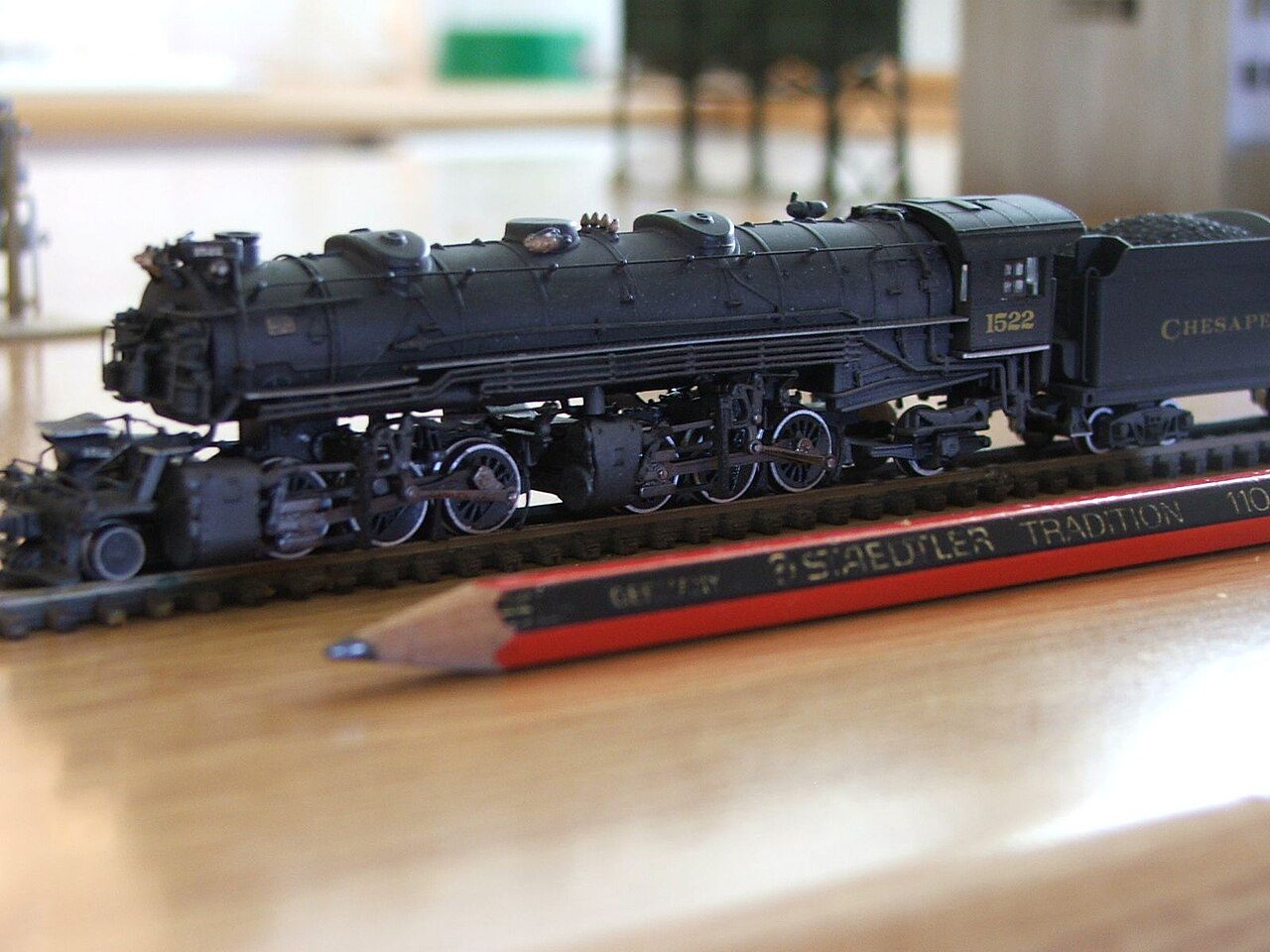
It suits someone who wants steam without paying for sound, because Bachmann sells the sound version as a separate set. The 4-6-0 is a small ten-wheeler, though the photo shows a larger Bachmann steam locomotive beside a pencil. That’s still a fair illustration of how small N scale is. If you do want sound, Bachmann also sells a 4-6-0 set with DCC sound, the Whistle-Stop Special, number 24133, and the last set below is the other sound option.
Bachmann Roaring Rails With Digital Sound
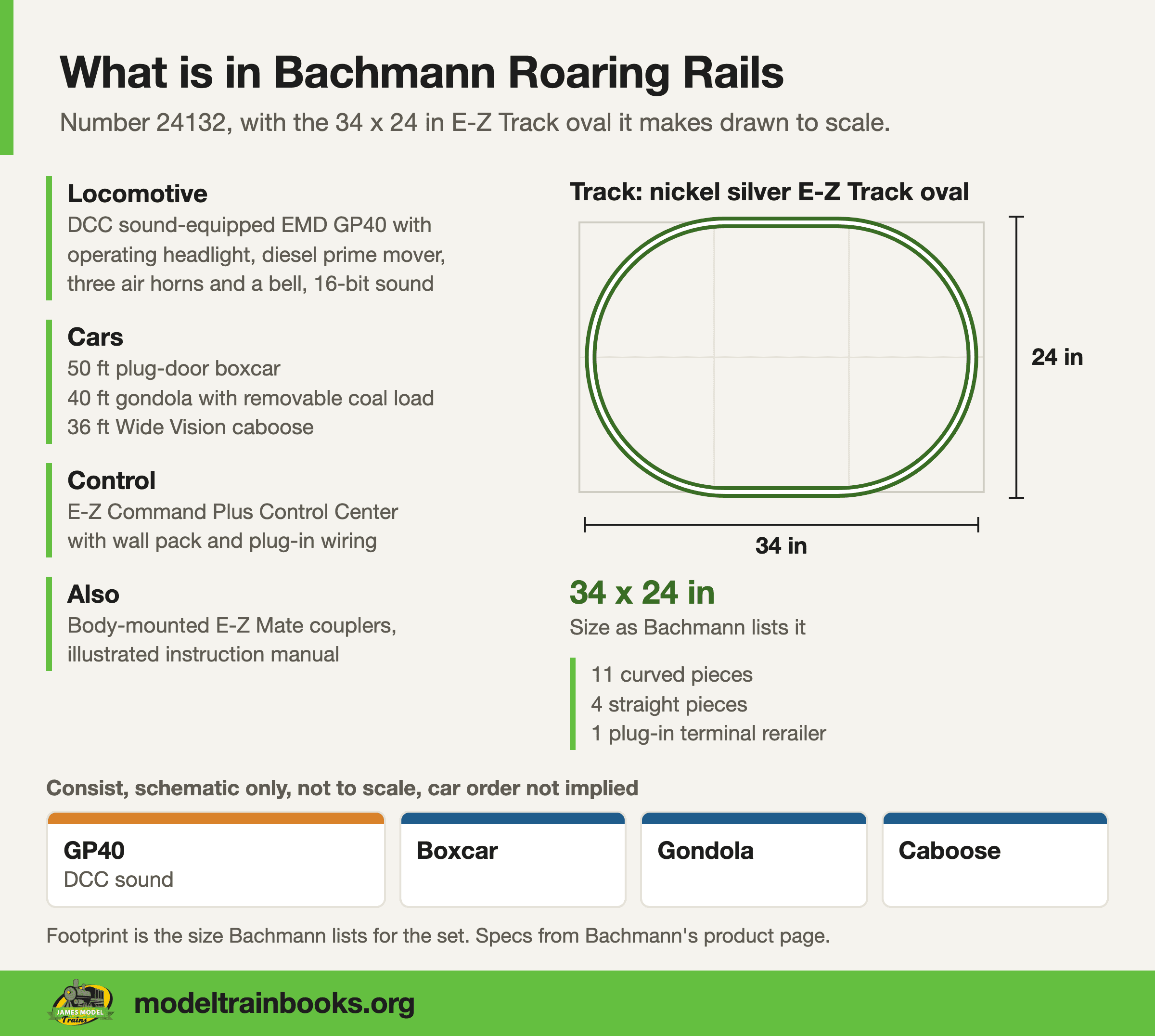
Roaring Rails, number 24132, is the sound option among these N scale train sets. Its GP40 is DCC sound-equipped, with a diesel prime mover, three air horns and a bell in 16-bit polyphonic sound. The set includes a plug-door boxcar, a gondola with a coal load and a caboose. Bachmann’s E-Z Command Plus control center and a wall pack run the show. The track is the 34 by 24 inch oval of nickel silver E-Z Track.
It suits the buyer who wants sound in the box and doesn’t want to purchase a decoder later. The control center is digital, so more decoder-equipped locomotives can share the oval, while the Kato sets above run on DC and need a decoder fitted for sound. That’s the real decision. You either pick Roaring Rails for sound now or a Kato set for the simplest start. If you still have questions about size, track or what to buy next, the answers below cover them.
FAQ About N Scale Train Sets
What is the size range of the N scale?
N scale is 1:160, so N scale train sets are about half the size of HO sets, which is why a whole oval fits on a table. Bachmann says a typical railcar measures about 4 inches by three quarters of an inch. A Kato starter oval runs about 52 by 25 inches, while Bachmann’s circle sets are 24 by 24 inches.
What’s the best N scale track?
For a starter set, the best track is the track in the box, because most N scale train sets include snap track. Kato sets come with Unitrack and Bachmann sets come with E-Z Track, and both snap together. The NMRA beginner guide also names Atlas, Micro Engineering and Peco, while Atlas sells a Code 80 Snap-Track starter set with no train or power pack.
Who makes the highest quality model train?
No single maker wins every category, so the better question is which catalog fits what you want. The NMRA beginner guide lists Athearn, Atlas, Bowser, Intermountain, Kato, Con-Cor and Micro-Trains as N scale sources. For a complete box, Kato and Bachmann are the two catalogs covered here, and Kato describes its starter locomotives as five-pole motor models.
What should I buy after an N scale starter set?
Buy track first, because a turnout and a few extra pieces turn a loop into a station with a siding. Kato sells Variation sets that add a passing siding, and Bachmann sells number 4 and number 6 E-Z Track turnouts. Then plan the table with our 3×6 N scale layouts or 4×8 N scale layouts.
Can I add DCC to a Kato N scale starter set?
Yes, you can. Kato Unitrack works with DCC, and the Gevo locomotive takes a drop-in decoder, but the Power Pack SX is DC only, so you would also need a DCC command station to power the track. Kato sells the Gevo with DCC or DCC plus sound already installed if you want to skip the fitting.